Airbus ACJ319 private jet charter

Airbus ACJ319 Charter

Airliner space, private-jet exclusivity.

PAX19RANGE6,750 nmSPEEDMach 0.82

OVERVIEW

Airbus ACJ319

The Airbus ACJ319 transforms a commercial A319 airframe into a private flying residence. Bedrooms, lounges, dining and conference rooms accommodate up to 19 passengers in airliner-scale space with 6,750 nm of intercontinental range.

Airbus ACJ319 cabin and exterior

IN DEPTH

The complete guide to chartering the Airbus ACJ319

The story behind the Airbus Corporate Jet ACJ319

The Airbus Corporate Jet ACJ319 represents one of aviation's most audacious propositions: take a proven, high-cycle narrow-body airliner — in this case the Airbus A319-100, the shortest member of the A320 family — strip out its 124-seat commercial cabin, fit the airframe with up to six additional centre fuel tanks totalling 5,820 additional litres, and hand it over to specialist completions houses to transform it into the most voluminous private aircraft money can buy.

The programme launched in 1997, with first deliveries in 1999, and was an immediate commercial success. The formula was compelling: for roughly the same purchase price as a Gulfstream G550 or Bombardier Global Express, buyers could acquire an aircraft with twice the floor area, three times the baggage volume and the ability to carry 19 passengers across 6,750 nautical miles — or a smaller party across more than 10,000 nautical miles with a full auxiliary fuel load. For heads of state, government ministries, sovereign wealth funds and the largest corporations on earth, it was an irresistible value proposition.

Airbus established its Corporate Jet Centre in Toulouse to coordinate outfitting, working with certified completions houses in Hamburg, Texas, Switzerland and the Far East to deliver interiors ranging from conservative corporate configurations to extraordinary private residences featuring dedicated bedrooms, dining saloons, living rooms, offices, shower suites and crew rest areas. Each ACJ319 is effectively a bespoke aircraft — no two interiors are identical.

The original ACJ319ceo entered what Airbus designates the current-engine-option phase alongside the launch of the re-engined ACJ319neo in 2018, featuring CFM LEAP-1A powerplants with dramatically improved fuel efficiency. Both generations remain active in the charter market, with the ceo variants commanding lower hourly rates and the neo variants offering extended range and a reduced environmental footprint. For the purposes of this guide, specifications refer to the widely available ACJ319ceo unless otherwise stated.
On board: the cabin

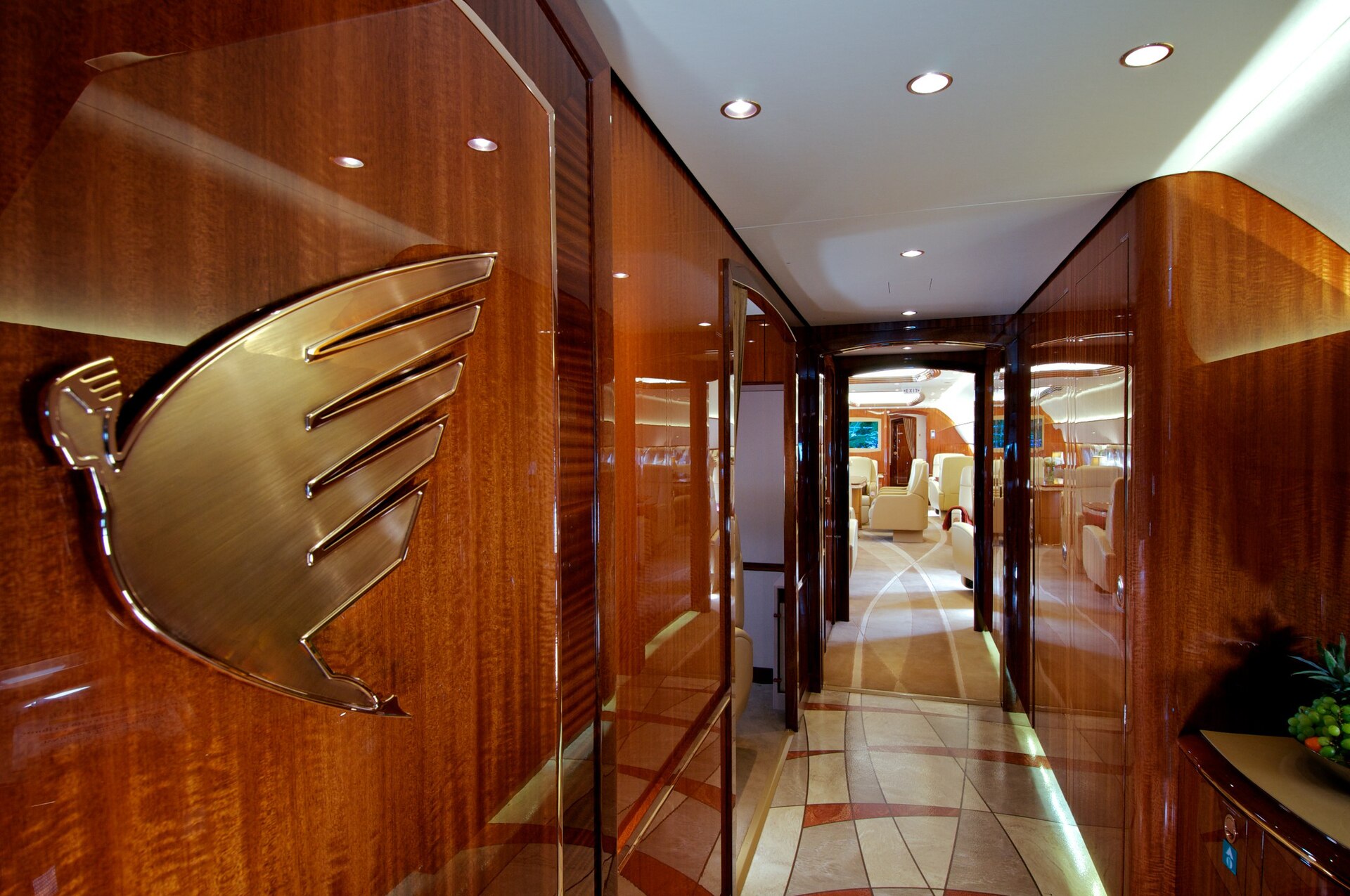
To step aboard an Airbus ACJ319 is to experience a categorical departure from conventional business jet travel. Where even the largest purpose-built business jets such as the Gulfstream G700 or Bombardier Global 7500 offer cabins measuring 56 to 57 ft in length and 8 to 9 ft in width, the ACJ319's usable cabin stretches to approximately 78 ft (23.8 m) in length and 12.96 ft (3.95 m) in width — dimensions that provide a total floor area approaching 800 sq ft, roughly equivalent to a comfortable studio flat in central London.

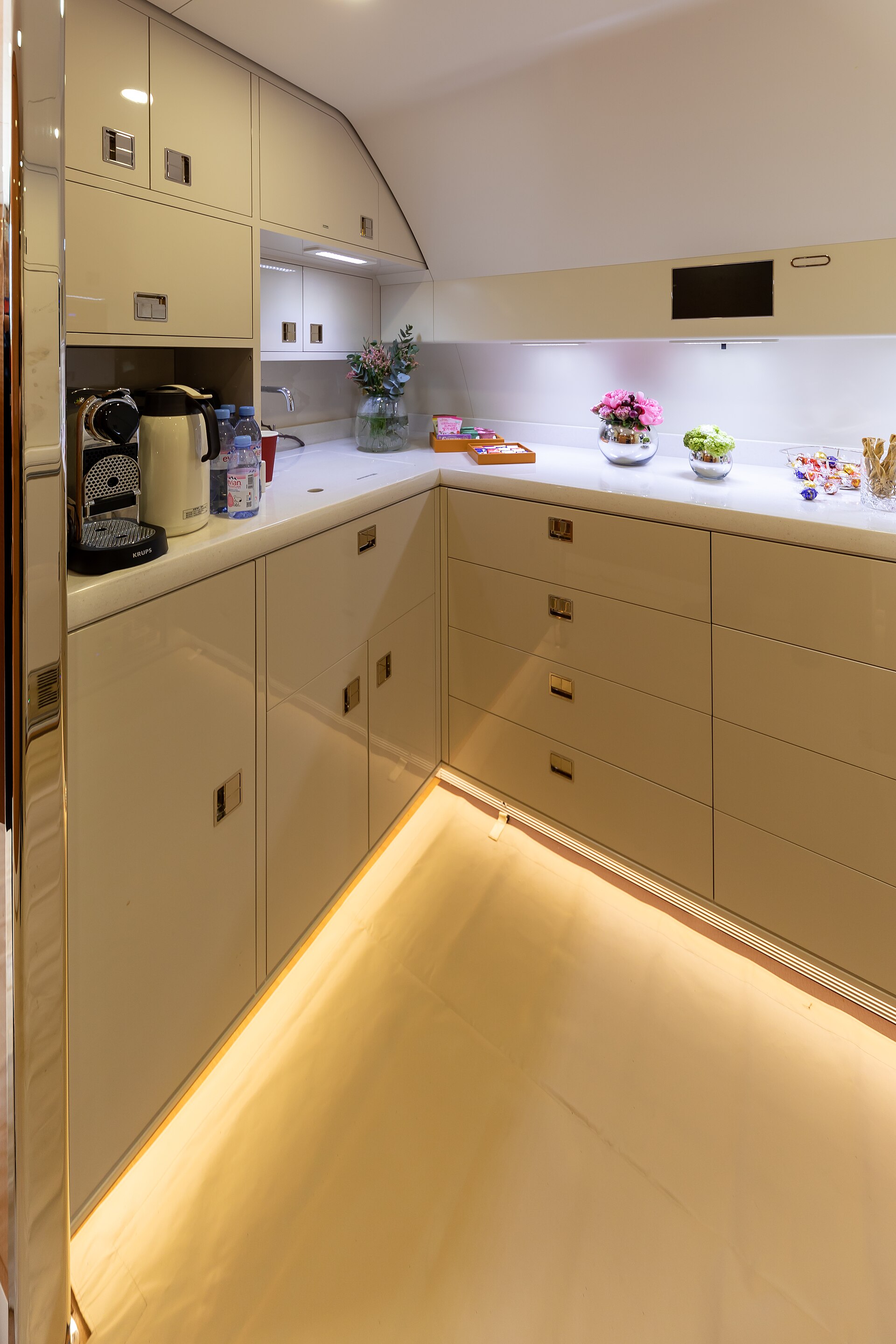
This extraordinary volume allows completions designers to create configurations that simply have no analogue in the dedicated business jet world. A typical 19-passenger charter-configured ACJ319 might include a forward executive lounge with six club seats and a central conference table, a mid-cabin dining area with six diner seats arranged in facing pairs, a private stateroom with a full queen-size bed, wardrobe and dressing area, a luxury bathroom with full-size shower and separate lavatory, a crew rest area, and an aft galley large enough to support in-flight catering from multiple simultaneous warming ovens.

Stand-up height of 7.38 ft (2.25 m) throughout the pressurised cabin is consistent with a commercial first-class cabin and exceeds any purpose-built business jet by a meaningful margin — a detail that sounds modest in specification but becomes immediately apparent when a six-foot-two passenger stands upright and walks the full length of the aircraft without the characteristic forward lean that even the tallest business jets require.

Connectivity on charter-available ACJ319s is typically delivered via Ku-band or Ka-band satellite internet with capacities adequate for video conferencing and secure file transfer. The cabin management system — from Lufthansa Technik, Diehl or equivalent specialist — controls lighting zones, window blinds, temperature sections and audio-visual equipment from a central touchscreen interface, allowing a party of 19 to customise their immediate environment independently of other zones.

Performance, range and runway access

The ACJ319's range depends directly on the number of auxiliary centre fuel tanks (ACTs) installed. In its maximum-range configuration with six ACTs, the aircraft carries sufficient fuel to fly approximately 6,750 nautical miles with a typical business payload — enough to reach New York from London non-stop, or Singapore from London with one en-route fuel stop. Some specialist operators fit partial ACT suites, trading range for interior volume, and these aircraft will typically achieve 5,000 to 6,000 NM depending on payload.

Two CFM56-5B5/P turbofan engines, each producing approximately 22,000 lbf of thrust, power the ACJ319 to a maximum cruise speed of Mach 0.82 and a service ceiling of 41,000 ft. The CFM56 is one of the most thoroughly tested and understood turbofan engines in aviation history, with over 30,000 examples in service across commercial and corporate fleets, and its reliability record is beyond reproach. Maximum take-off weight is 75,500 kg (166,450 lb), reflecting the ACT fuel load and structural reinforcements applied to the corporate version.

The service ceiling of 41,000 ft is notably lower than the 51,000 ft available on the Gulfstream G700, Global 5000 and Global 6000, meaning the ACJ319 operates within the same flight levels as commercial airliners on busy routes such as the North Atlantic. This is not a meaningful operational disadvantage on most routes, but it does mean the aircraft is more susceptible to routing around weather systems that purpose-built business jets can simply overfly, and it shares airspace with commercial traffic more frequently.

Runway requirements of approximately 7,200 ft at maximum take-off weight in sea-level standard conditions limit the ACJ319's airport access somewhat compared with purpose-built business jets. London Heathrow, Gatwick, Stansted and Luton are all fully accessible; London City Airport is not, due to both runway length and approach gradient constraints. For international operations, the ACJ319's commercial-aircraft pedigree means that virtually every ICAO-registered airport with a 2,200 m runway can accommodate it, making it highly accessible at major international hubs.

Signature missions and best routes

The ACJ319's defining mission is the movement of a large, high-value party — 12 to 19 passengers — over intercontinental distances in an environment of absolute comfort and privacy. London to New York (3,459 NM) can be accomplished non-stop in approximately 8 hours 45 minutes with a full passenger load and auxiliary fuel tanks, though many operators choose to carry a lighter fuel load and fly a single technical stop in Reykjavik or Shannon in exchange for a more generously configured interior.

Government and diplomatic charter represents the highest-density use case for the ACJ319 in the European market: ministerial delegations, state visits and multilateral diplomatic missions regularly charter the type precisely because its cabin can be configured with a private stateroom for the principal, a delegation working area, a communications suite and a crew rest space within the same pressurised environment — a combination that is simply impossible to achieve on any purpose-built business jet.

London to the Gulf region — Dubai (3,405 NM), Riyadh (3,574 NM), Doha (3,265 NM) — is a high-volume ACJ319 mission segment, particularly for corporate groups where 15 to 19 senior executives need to travel together for investor days, site visits or board meetings. The ACJ319 delivers them collectively rather than forcing the group to charter two or three mid-size aircraft, with significant savings in logistics co-ordination and a materially superior cabin environment for each individual passenger.

Trans-Pacific routing — typically London to Hong Kong or Singapore with a single stop in Dubai or Muscat — is achievable with careful weight management, and the ACJ319 is regularly operated on these routes by Asian governments and major financial institutions. Long sectors of this type play directly to the aircraft's strengths: the private bedroom and shower allow the principal to arrive rested regardless of departure time, and the large dining area allows formal business entertaining in flight.

Operating economics and charter pricing

The ACJ319 commands charter rates of approximately £15,000 to £25,000 per flight hour in the 2024–25 market, reflecting its extraordinary cabin volume, the complexity of its operating and maintenance infrastructure, and the relatively limited number of charter-available examples relative to the total fleet. The higher end of this range applies to near-new or freshly refurbished examples with premium completions and full Ka-band connectivity; older or more simply equipped aircraft can be found at the lower end.

For a transatlantic mission, a London to New York (3,459 NM) one-way charter on an ACJ319 will typically invoice at £150,000 to £220,000 all-in, depending on aircraft specification and operator. On a per-passenger basis for a party of 19, this equates to approximately £8,000 to £11,500 per seat — broadly competitive with commercial first class on the same routing when the productivity gains, privacy and time savings of private terminal access are factored into the comparison.

London to Dubai (3,405 NM) runs approximately £120,000 to £180,000 one-way for the full aircraft. At 19 passengers, the per-seat cost drops to £6,300 to £9,500 — demonstrating the per-passenger cost advantage for large groups clearly. For groups of fewer than eight passengers, however, the economics reverse decisively: a Global 6000 or G700 delivers equivalent or superior per-passenger comfort at meaningfully lower total cost, and with better runway flexibility.

Annual operating costs for the ACJ319 reflect its commercial-aircraft heritage: CFM56 engine maintenance is managed under power-by-the-hour programmes at costs comparable to commercial airline engine reserves on a per-hour basis, and airframe maintenance under EASA Part M is straightforward given the density of A319 maintenance network coverage worldwide. The main variable in ACJ319 operating economics is interior refurbishment, which typically occurs on a seven-to-ten-year cycle at a cost of £5 million to £15 million depending on specification ambition.

How the ACJ319 compares

The ACJ319's comparison set is unusual because it does not fit neatly into the conventional business jet hierarchy. It has more cabin volume than any purpose-built business jet, but a lower cruise speed, a lower service ceiling and higher per-hour operating costs than the Gulfstream G700 or Global 6000. It is not a better aircraft than those types in an objective sense; it is a categorically different aircraft that is better in some specific contexts and worse in others.

Against the Boeing BBJ 737-700, its most direct competitor in the VIP narrowbody segment, the ACJ319 offers a slightly shorter cabin (78 ft versus 79.2 ft) but a broader fuselage cross-section in terms of interior width — 12.96 ft to the BBJ's 11.58 ft — creating a more generous lateral envelope for bespoke suite configurations. Both aircraft operate at Mach 0.82 cruise and 41,000 ft ceiling. Charter rates for the two types are broadly comparable, with the BBJ typically running £1,000 to £3,000 per hour cheaper due to lower per-hour maintenance costs on the CFM56-7B versus the CFM56-5B.

Against the Gulfstream G700 — the largest purpose-built business jet in charter service — the ACJ319 offers more floor area and more standing height, but the G700 counters with a 51,000 ft ceiling, Mach 0.925 cruise, 7,500 NM non-stop range and the ability to operate from runways that the ACJ319 cannot access. For groups of 19 on a London to New York sector, the ACJ319 may be marginally preferable on cabin experience for certain configurations; for any mission beyond 6,750 NM or any routing through a short-runway airport, the G700 wins categorically.

The ACJ319 is genuinely peerless in one specific application: the movement of 15 to 19 VIP passengers in a fully customised private environment over distances of 3,000 to 6,750 NM. In that niche, no other aircraft comes close.

Verdict: who should charter the ACJ319?

The Airbus ACJ319 is the right charter aircraft for clients who are moving a large, high-value group and for whom the quality of the in-flight environment is a direct reflection of organisational standards or personal brand. State and government delegations, major sporting organisations, large family offices travelling together, and corporate boards conducting full-team off-site meetings in transit are the primary client archetypes for whom the ACJ319 is not merely an option but the only rational choice.

A board of 15 senior executives chartering an ACJ319 from London to a Gulf investor day can use the six-hour flight as a productive session: the forward conference area accommodates a full team briefing, the aft dining zone serves a formal working lunch, and individual preparation time in the private stateroom is available for the chief executive before arrival. No other aircraft delivers this combination of group productivity infrastructure and individual privacy at 40,000 ft.

The ACJ319 also makes compelling sense for ultra-high-net-worth family travel where multiple generations are travelling together — grandparents, parents and children requiring genuinely separate areas for sleeping, play and quiet rest. The cabin's physical separation of zones, reinforced by pocket doors and independent climate control, allows each family group to inhabit their own environment within the same pressurised tube, an experience that converts a long international flight from an ordeal into a genuinely enjoyable shared journey.

For solo travellers, couples or small parties of fewer than eight passengers, the ACJ319 is rarely the most economical or efficient choice: a Global 6000 or Gulfstream G700 will provide equivalent or superior cabin quality per person at substantially lower total cost. The ACJ319 is an aircraft of scale — the more passengers share it, the more extraordinary the value proposition becomes, and the more its unique cabin volume justifies the premium over the purpose-built alternatives.

PHOTO GALLERY

Airbus ACJ319 — exterior & cabin

Reference photography of the Airbus ACJ319 (and sister types within the same cabin family where noted). Images sourced from Wikimedia Commons under Creative Commons licences.

EXTERIOR

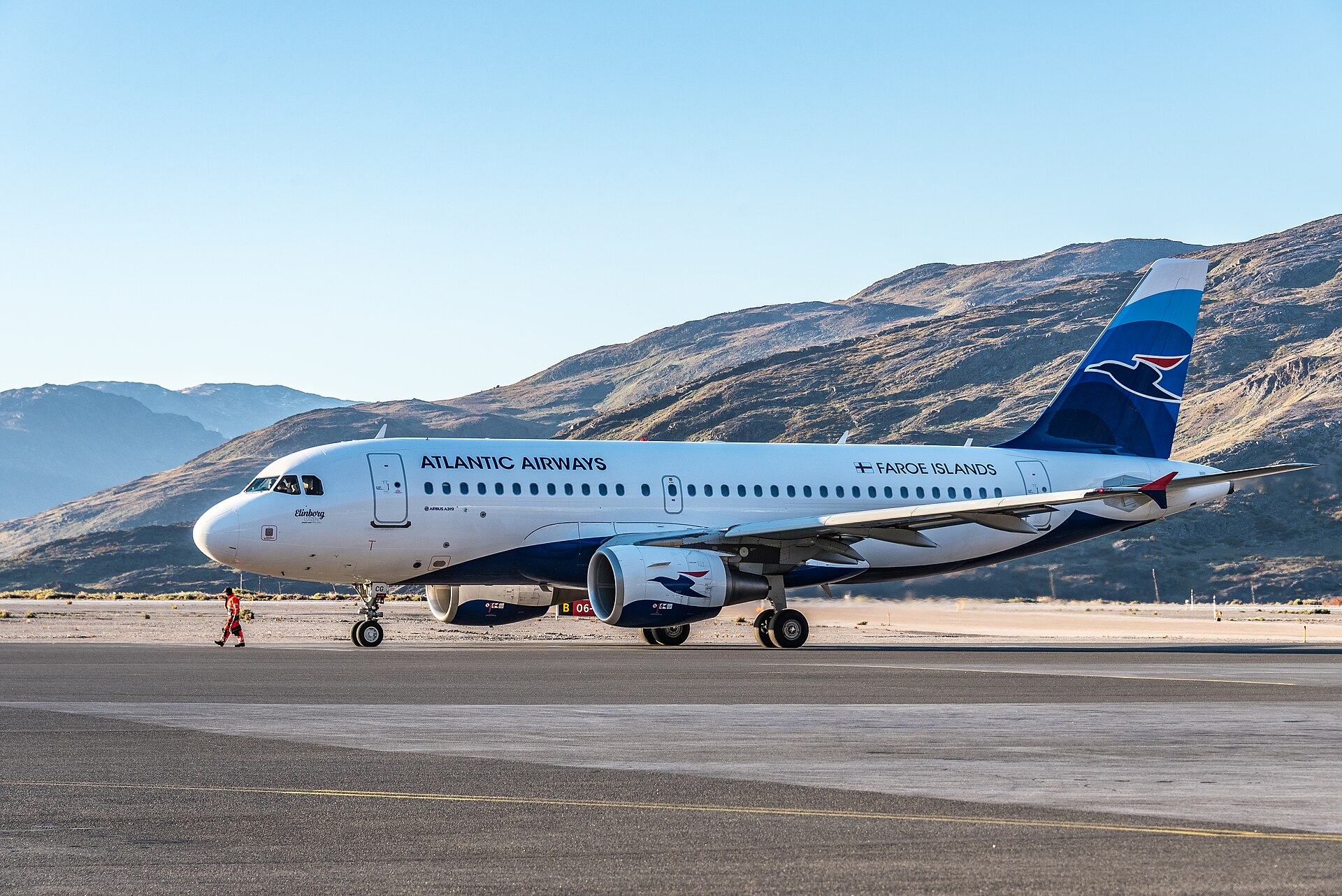
2017-09-12 Atlantic Airways (Faroe Islands) Airbus A319 aircraft (OY-RCG) at Narsarsuaq, Greenland
2017-09-12 Atlantic Airways (Faroe Islands) Airbus A319 aircraft (OY-RCG) at Narsarsuaq, Greenland · Gordon Leggett · CC BY-SA 4.0 via Wikimedia Commons
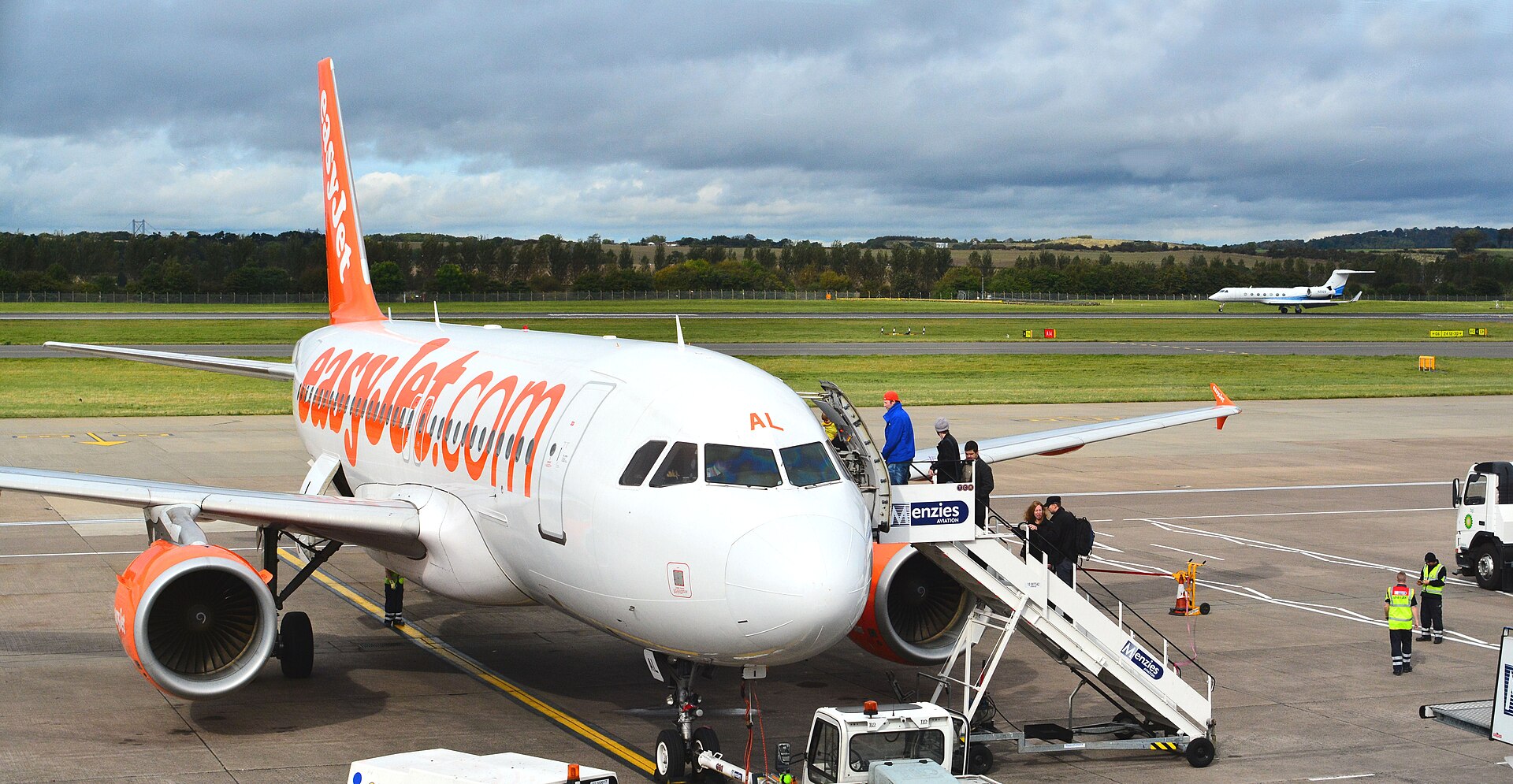
Airbus 319 and Gulfstream G550 (47090376391)
Airbus 319 and Gulfstream G550 (47090376391) · Mike McBey · CC BY 2.0 via Wikimedia Commons

INTERIOR

Comlux Airbus ACJ319 VVIP interior
Comlux Airbus ACJ319 VVIP interior · Comlux Aviation Group · CC BY-SA 3.0 via Wikimedia Commons
EBACE 2023, Le Grand-Saconnex (EB237714)
EBACE 2023, Le Grand-Saconnex (EB237714) · Matti Blume · CC BY-SA via Wikimedia Commons

SPECIFICATIONS

Airbus ACJ319 specifications

Passengers19
Range6,750 nm
SpeedMach 0.82
Cabin height7'4"
Cabin width12'1"
BaggageUnlimited
Runway6,500 ft

CABIN EXPERIENCE

On board the Airbus ACJ319

  • Multiple bedrooms with en-suite
  • Conference room seating 12
  • Two crew rest areas
  • Full galley with chef station

BEST ROUTES

Where the ACJ319 flies best

London → Maldives

from £285,000

Riyadh → New York

from $345,000

BROWSE ALL ROUTES →

CHARTER PRICING

Airbus ACJ319 charter pricing

ROUTEESTIMATED PRICE
Geneva → Tokyofrom CHF 425,000
London → Cape Townfrom £325,000

Indicative all-inclusive one-way pricing — aircraft, crew, fuel, handling, catering and taxes. Confirmed quote in 10 minutes.

Why choose the Airbus ACJ319?

  • True airliner cabin volume
  • Bedrooms and conference room
  • Intercontinental range for 19 passengers

FAQ

Frequently asked

Is Wi-Fi available onboard?

Yes — most aircraft in this class offer high-speed Ka-band or Starlink connectivity suitable for video calls and streaming throughout cruise.

Can pets fly on board?

Pets travel in the cabin alongside their owners on every Limitless Sky charter at no extra charge. Tell us the species and weight when you request a quote.

How quickly can the aircraft be ready?

Once a quote is confirmed, this aircraft can typically be positioned within 2–4 hours anywhere in its home region, and within 24 hours globally.

SIMILAR AIRCRAFT

Also in VIP Airliner

HEAD-TO-HEAD

Compare the ACJ319

ALL COMPARISONS →

AIRBUS ACJ319 CLUSTER

Everything connected to the Airbus ACJ319

Ready to charter the Airbus ACJ319?

Quotes in 10 minutes. Aircraft positioned within hours. 24/7, worldwide.

REQUEST A QUOTE