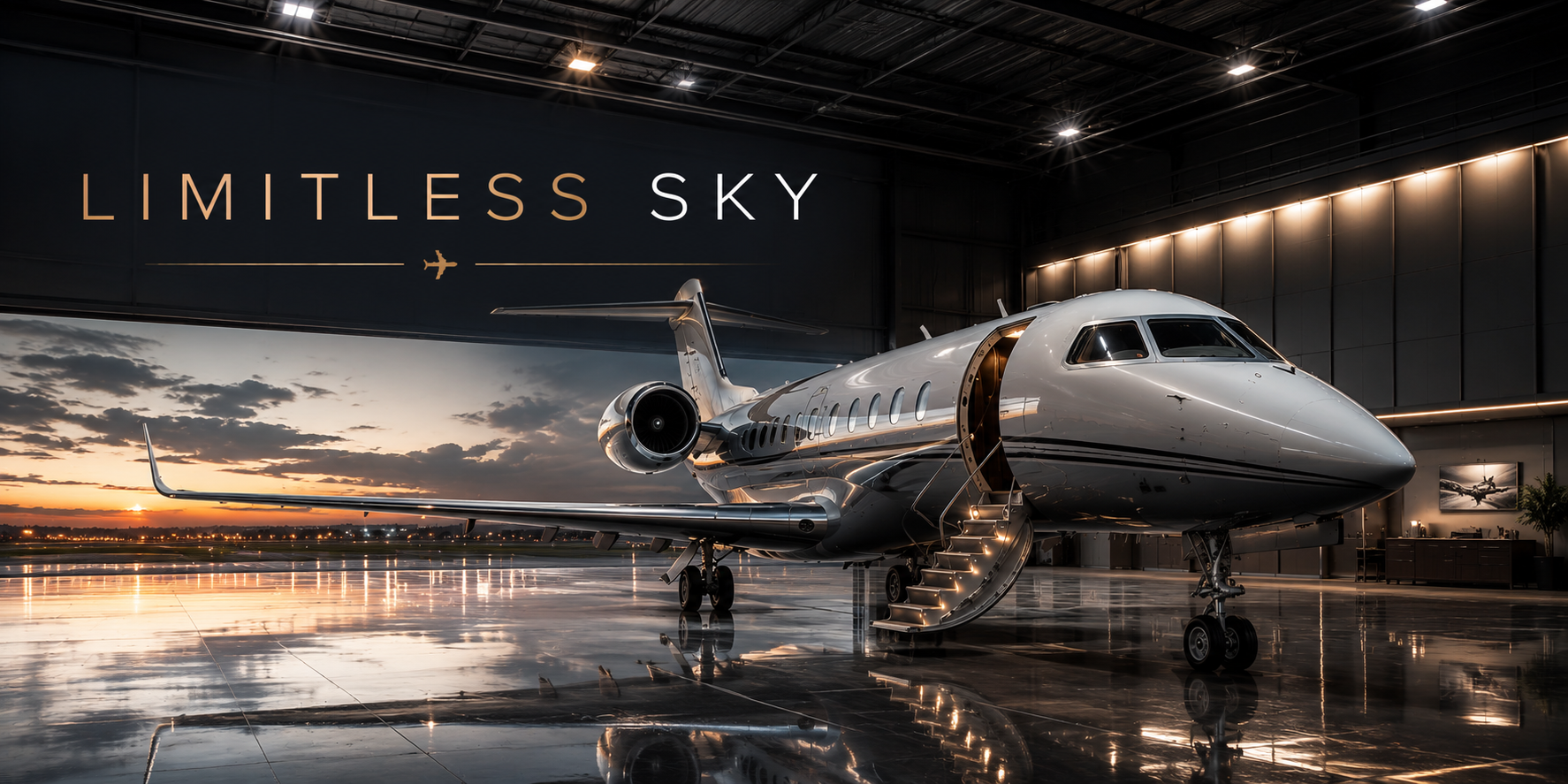
Best executive jets ranked by mission (2026 shortlist)
Rank the aircraft by what you actually fly — not brochure range. This is the desk shortlist when clients ask for the best business private jet by mission type.
| Mission | #1 pick | Runners-up | Why it wins |
|---|---|---|---|
| EU day trip (<2h, 4–6 pax) | Phenom 300E | CJ3+, PC-24 | Lowest cost per productive hour; dense FBO coverage |
| US coast-to-coast | Challenger 3500 | Praetor 600, G280 | Stand-up cabin + non-stop range without ULR rates |
| Global / transatlantic | Gulfstream G700 | Global 7500, Falcon 8X | Bedroom + Jet ConneX/Starlink for full workday |
Business jet internet — connectivity by type (typical, not guaranteed)
Business jet internet varies by tail number and retrofit date. Label every row below as typical fleet fit-out — always confirm Ka-band or Starlink on the specific aircraft before you book a video-critical leg.
| Aircraft type | Typical Wi-Fi | Video calls? | Desk note |
|---|---|---|---|
| Phenom 300E / CJ3+ | Gogo AVANCE L5 (US) / SwiftBroadband | US only reliably | Add Jet ConneX retrofit on EU-heavy missions |
| Citation Latitude | Gogo L5 or Jet ConneX (Ka) | Yes on Ka tails | Most common corporate mid in Europe |
| Challenger 350 / 3500 | Jet ConneX Ka-band | Yes | Standard on 2019+ deliveries |
| Praetor 600 | Jet ConneX (standard) | Yes | Lowest cabin altitude in class — less fatigue |
| G500 / G600 / G700 | Jet ConneX or Starlink Aviation | Yes | Starlink rolling out on newest serials |
| Global 7500 | Jet ConneX Ka-band | Yes | Four-zone cabin — team can work in parallel |
| Falcon 8X | Jet ConneX or Starlink (select tails) | Yes | Quietest cabin — best for calls without headsets |
What makes a great executive jet?
A business private jet is judged by very different criteria than a leisure aircraft. Owners and corporate buyers care less about top speed than about whether the cabin supports a full board meeting at 41,000 feet, whether the Wi-Fi sustains a two-hour video call across the Atlantic, and whether the airframe can fly the company's actual route map without a fuel stop. The five criteria that decide every executive jet ranking are connectivity, cabin productivity, speed, range and airport access.
- —Wi-Fi that holds Zoom / Teams video on long legs (Jet ConneX Ka-band or Starlink Aviation)
- —Cabin layout: forward club-four for working sessions, aft conference grouping or divan
- —Quiet acoustics so calls are usable without headsets
- —Power and USB-C at every seat plus deployable monitors
- —Non-stop range to your top three city pairs without a tech stop
- —Speed and short-runway access to keep total door-to-door time low
In-flight Wi-Fi — what actually works at 41,000 ft
Connectivity is the single biggest productivity lever. The current best-in-class options:
- —Starlink Aviation — 200–350 Mbps, sub-50 ms latency, the new benchmark for video conferencing on every continent
- —Inmarsat Jet ConneX (Ka-band) — 50–150 Mbps, global coverage including oceanic, the long-running corporate standard
- —Viasat Ka-band — high throughput over North America and Europe, weaker oceanic
- —Gogo AVANCE L5 / Gogo 5G — fast 4G/5G air-to-ground over the US, low cost
- —SwiftBroadband / SBB — legacy L-band, only suitable for email and basic browsing
Best executive jet — light category (1–2 hour business hops)
For short European or US-regional sectors with two to six passengers. The Phenom 300E is the clear leader: largest cabin in class, optional Gogo AVANCE L5, low operating cost and a 2,000 nm range that opens up most intra-continental business routes. The Citation CJ3+ is a reliable second choice. The Pilatus PC-24 adds short-runway and unimproved-field capability — a unique pick if you need direct access to corporate or regional airfields.
Best executive jet — midsize category (3–4 hour intra-continental)
The 'workhorse' tier. The Citation Latitude is the most common pick for corporate flight departments: full stand-up cabin, flat floor, six club seats plus a three-place divan, Gogo AVANCE L5 standard, and a real-world block-to-block cost notably below super-midsize rivals. The Praetor 500 / 600 is the modern challenger — Jet ConneX standard, lowest cabin altitude in class (5,800 ft at FL450), full fly-by-wire and best-in-segment range. The Hawker 800XP and Legacy 500 remain solid value picks on the used charter market.
Best executive jet — super-midsize (transcontinental US, intra-Europe)
The Bombardier Challenger 350 / 3500 is the benchmark — eight-passenger cabin, stand-up flat floor, segment-leading payload and 3,200 nm range. Coast-to-coast US, London → Dubai, or three days of European multi-city tours without refuelling. The Gulfstream G280 is faster cruise, slightly smaller cabin. The Praetor 600 sits between the two: longest range in class (4,018 nm), full Jet ConneX, lowest cabin altitude.
Best executive jet — heavy (transatlantic productivity)
The Gulfstream G500 and G600 define the modern heavy executive jet: clean-sheet cabin, ten oversized windows, Symmetry fly-by-wire flight deck, full Jet ConneX, and ranges of 5,200 and 6,500 nm. London → New York eastbound or Dubai → London with full passenger load, all-cabin productivity. The Falcon 2000LXS and Challenger 650 are quieter and have shorter-runway capability — useful for London City–compatible operations and into smaller business fields.
Best executive jet — ultra-long-range (global non-stop)
The G700 (7,750 nm) and Global 7500 (7,700 nm) are the global flagships — five living zones, a dedicated bedroom, full crew rest and Jet ConneX or Starlink throughout the cabin. The G650ER (7,500 nm) remains in production demand for being faster on most real-world legs and quieter than its successor. The Falcon 8X is the quietest cabin and lowest cabin altitude of any production business jet — ideal when sleep on a westbound transatlantic matters as much as work on the eastbound.
Cabin configurations that actually support work
- —Forward club-four + aft three-place divan — most-used corporate layout, supports two working teams of four
- —Centre conference grouping with deployable 4K monitor — for live board presentations
- —Aft private bedroom with full ensuite — overnight transcontinental productivity
- —Crew rest module — required above ~10 hours' flight time for continuous productivity
- —Dedicated phone-call privacy zone — usually a forward jump-seat area with door
Speed and time saved — what the Mach number actually buys
Speed matters most on legs where you can stay above Mach 0.88 for two hours or more. On a London → Dubai super-midsize sector, the Praetor 600 at Mach 0.83 and a Challenger 350 at Mach 0.82 are within twelve minutes of each other. On a London → New York heavy leg, a G700 cruising at Mach 0.90 saves 30–40 minutes over a slower heavy. The Citation X+ remains the fastest civilian aircraft at Mach 0.935 — meaningful on transcontinental US sectors, less so on shorter European hops.
Operating costs and charter rates (2026)
- —Phenom 300E — $4,200–$4,800 / hour
- —Citation Latitude — $5,800–$6,800 / hour
- —Praetor 600 — $6,500–$7,500 / hour
- —Challenger 350 / 3500 — $7,000–$8,200 / hour
- —Gulfstream G500 — $9,800–$11,500 / hour
- —Gulfstream G700 — $13,500–$16,500 / hour
- —Global 7500 — $14,000–$17,000 / hour
How to choose your business jet — a decision framework
- —If 90% of your sectors are under 2 hours with ≤6 passengers — Phenom 300E or Citation CJ3+
- —If you fly 3–4 hour sectors across Europe or US-regional with 6–8 — Citation Latitude or Praetor 500
- —If you fly transcontinental US or intra-Europe-plus-Gulf with 8 — Challenger 350 or Praetor 600
- —If you fly transatlantic on a known route map with 8–12 — Gulfstream G500 / G600
- —If you need global non-stop with a bedroom and 12+ seats — G700 / Global 7500 / G650ER / Falcon 8X
- —If runway access is the constraint (London City, alpine, island fields) — Pilatus PC-24, Falcon 2000LXS, Challenger 650
Cabin-as-office features that matter
- —Forward club-four + aft divan — two working teams of four without crowding
- —Centre conference four with deployable 4K monitor — live board presentations
- —Aft berths / stateroom — overnight transatlantic with morning arrival ready
- —Dedicated phone-call zone (forward jump seat or enclosed lav) — confidential calls
- —Quiet zones — Falcon 8X (~49 dB) and Global 7500 lead for call clarity
Cost per productive hour vs first class
Compare door-to-door time, not seat price. A London → Geneva round trip on commercial business class might run £2,800–£4,500 all-in with lounge and car — but absorbs 6–8 hours of calendar time. A Phenom 300E charter on the same pair (€6,500–€14,000 one-way) saves 3–4 hours each direction and delivers a full working cabin for the block time.
On transatlantic sectors, first class on BA or Emirates runs £6,000–£12,000 one-way with fixed schedules and shared terminals. A Gulfstream G500 charter (£85,000–£115,000 one-way London–New York) looks expensive per seat — but for a team of six the cost per productive hour (~£1,400/hr split across six workstations) often beats six business-class tickets plus lost meeting time.
Charter or own?
For most companies flying 25–250 hours per year, on-demand executive jet charter is the most efficient option: pay only for the hours you fly, switch aircraft category by mission, and avoid the fixed costs of crew, hangar, maintenance and depreciation. Jet cards and memberships make sense from ~100 hours/year when guaranteed availability and locked pricing matter. Full ownership becomes economic above ~400 hours/year of single-aircraft use. See our companion guides on private jet pricing, jet card memberships and fractional ownership for the detailed comparison.
Referenced aircraft — jump to specs, cabin and hourly charter cost
Every business private jet named in this guide has a dedicated charter page with full specs, cabin plans and typical 2026 hourly rates. Use the links below to dive into each model, or open the head-to-head comparisons to see which one fits your route map.
- Embraer Phenom 300E charter →Light — 1–2 hr business hops
- Cessna Citation Latitude charter →Midsize — 3–4 hr sectors
- Embraer Praetor 600 charter →Super-mid — transatlantic capable
- Bombardier Challenger 350 charter →Super-mid workhorse
- Gulfstream G500 charter →Heavy — transatlantic productivity
- Gulfstream G700 charter →Ultra-long-range flagship
- Bombardier Global 7500 charter →Ultra-long-range, largest cabin
- Dassault Falcon 8X charter →Quietest ULR cabin, London City certified
Head-to-head — the executive-jet matchups buyers ask for
The decisions above almost always come down to a straight two-way comparison. These pages break down cabin, range, speed and 2026 charter cost side-by-side.
By manufacturer — full brand fleets and hourly rates
Every manufacturer hub aggregates the full charter fleet from that OEM with specs, current hourly rates and internal comparisons.
FAQ
Frequently asked
What is the best executive jet in 2026?
There is no single answer. The Challenger 350 / 3500 leads super-midsize, the Citation Latitude leads midsize, the Gulfstream G500 leads heavy, and the G700 leads ultra-long-range. The right answer is the one that flies your top three city pairs non-stop with the cabin layout your team works in.
Which business jet has the best Wi-Fi?
Any aircraft equipped with Starlink Aviation — 200–350 Mbps and sub-50 ms latency. Inmarsat Jet ConneX (Ka-band) is the long-running corporate standard at 50–150 Mbps.
Can I make video calls in flight?
Yes — on any aircraft equipped with Jet ConneX or Starlink, video conferencing is fluid throughout cruise.
What is the most popular corporate jet?
Globally, the Cessna Citation family and Bombardier Challenger 350 lead corporate flight-department fleets by units delivered.
What is the fastest executive jet?
The Cessna Citation X+ at Mach 0.935 max cruise — followed by the Gulfstream G700 and Global 7500 at Mach 0.925.
What are business private jets?
Business private jets are aircraft configured specifically for corporate travel — cabins optimised for productivity (club-four seating, conference tables, deployable monitors), high-throughput Wi-Fi for video conferencing, and the range to fly a company's top city pairs non-stop. They span from light jets like the Phenom 300E to ultra-long-range flagships like the Gulfstream G700.
How much does a business jet charter cost per hour in 2026?
2026 indicative rates: light jets (Phenom 300E) $4,200–$4,800/hr, midsize (Citation Latitude) $5,800–$6,800/hr, super-midsize (Challenger 350) $7,000–$8,200/hr, heavy (G500) $9,800–$11,500/hr, ultra-long-range (G700 / Global 7500) $13,500–$17,000/hr. Empty-leg pricing can be 30–70% below these ranges.
Which business jet is best for transatlantic productivity?
The Gulfstream G500 and G600 lead the working-transatlantic bracket: Jet ConneX standard, ten oversized windows, quiet cabin, and 5,200 / 6,500 nm range. For overnight sleep with morning productivity, the Falcon 8X's 49 dB cabin and 3,900 ft cabin altitude at FL410 is the class benchmark.
Which executive jet has the largest cabin?
The Bombardier Global 7500 has the largest cabin of any purpose-built business jet — 2,637 cu ft, four true living zones, a dedicated bedroom and full-size galley. The Gulfstream G700 is a very close second and cruises faster on most sectors.
Do business jets have private bedrooms?
Ultra-long-range jets do: G700, G650ER, Global 7500, Falcon 8X and BBJ/ACJ VIP airliners all offer an aft private stateroom with a full-size bed and ensuite lavatory. Heavy jets like the Falcon 2000LXS convert the aft divan into a two-person berth; midsize and super-midsize jets do not offer true bedrooms.
Can I bring my dog on a business jet?
Yes — pets travel in the cabin on private charter. There are no size or breed restrictions from the operator's side, though some destinations require paperwork (EU pet passport, US CDC import rules, UK PETS scheme) that we handle as part of the trip planning.
How far in advance should I book an executive jet?
For a specific date and aircraft type, 5–10 days out is comfortable. Same-day and next-day departures are routinely quoted on empty legs and repositioning flights. Peak weeks (Davos, Cannes Film Festival, Monaco GP, F1 finals, Christmas/New Year) should be booked 3–6 weeks out.
How do I get a private jet quote?
Send your route, dates and party size via the Limitless Sky contact form. A confirmed all-inclusive options within 1–2 hours, 24/7.