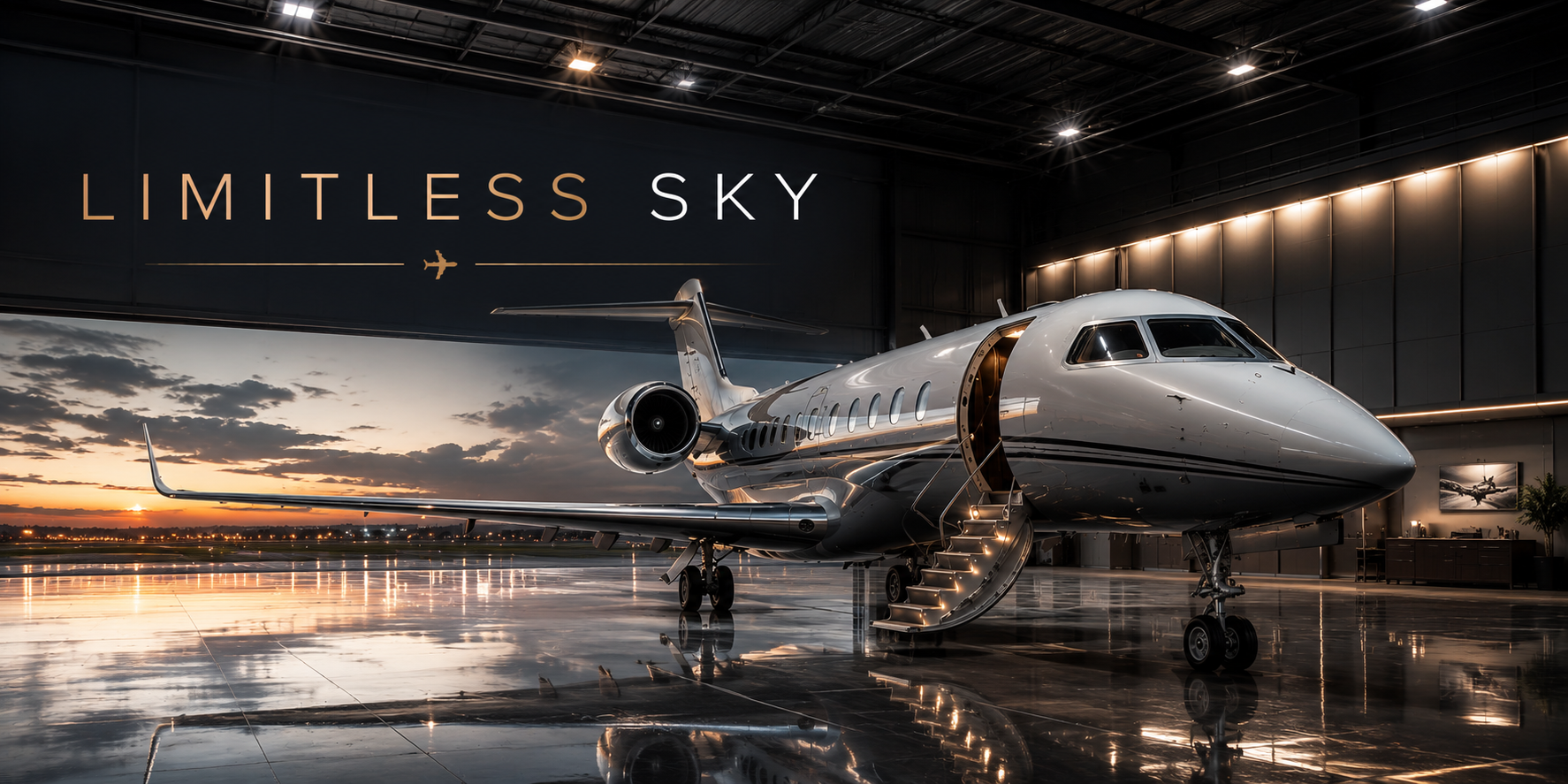
What defines a heavy jet?
Heavy jets sit between super-midsize and ultra-long-range aircraft. They have a range of roughly 5,500–7,000 nautical miles, full standing-height cabins (usually 6'1"–6'2"), seating for 10–14 passengers and the ability to carry a full payload across an ocean. They are the workhorses of intercontinental private aviation — typically the right aircraft for any trip above 6 hours block time with more than 6 passengers.
The three benchmark heavy jets in 2026
Three aircraft dominate the heavy jet charter market: the Bombardier Global 6000, the Dassault Falcon 7X (and its successor the 8X) and the Gulfstream G550. Each has a distinct philosophy on cabin layout, fuel economy and range — and all three are widely available on the charter market.
- —Bombardier Global 6000 — 6,000 nm range, three living zones, the most spacious cabin in the segment
- —Dassault Falcon 7X — 5,950 nm range, three engines, lower fuel burn, exceptional short-field performance
- —Gulfstream G550 — 6,750 nm range, fast cruise (Mach 0.87), large oval windows, the most-flown heavy jet in the world
- —Gulfstream G450 — 4,350 nm range, slightly smaller but very widely available at lower hourly rates
- —Bombardier Challenger 605 / 650 — 4,000 nm range, exceptional value for shorter heavy missions
Real 2026 heavy jet charter costs
Heavy jet hourly rates in 2026 sit between $9,000 and $13,000 depending on aircraft and operator. The figures below are realistic all-inclusive quotes from the Limitless Sky desk on the most-requested intercontinental sectors.
- —London → New York (Global 6000) — from £85,000
- —London → Dubai (Falcon 7X) — from £72,000
- —London → Maldives (G550, one-stop) — from £125,000
- —Dubai → London (Global 6000) — from $98,000
- —Dubai → Maldives (heavy jet, non-stop) — from $62,000
- —New York → London (Global 6000) — from $115,000
- —New York → Los Angeles (Falcon 7X) — from $58,000
- —Geneva → New York (G550) — from €95,000
Cabin and range comparison
- —Global 6000 — 3 zones, dedicated stateroom option, longest cabin (43'3"), six-foot crew rest
- —Falcon 7X — 3 zones, quietest cabin in segment, three-engine redundancy for oceanic routes
- —G550 — 3 zones, fastest cruise speed, signature large oval windows, the most widely supported aircraft globally
- —Range: G550 (6,750 nm) > Global 6000 (6,000 nm) > Falcon 7X (5,950 nm)
- —Top speed: G550 (Mach 0.87) > Global 6000 (Mach 0.85) > Falcon 7X (Mach 0.84)
- —Passenger capacity: typically 12–14 in club configuration, 8 in sleeping configuration
When is a heavy jet the right answer?
- —Transatlantic and transcontinental trips above 6 hours block time
- —Parties of 8 or more passengers travelling long-haul
- —Trips requiring true sleeping configurations (multi-day, overnight crossings)
- —Missions into airports with limited ground support where redundancy matters
- —Repositioning crews and passengers together on intercontinental sectors
When a heavy jet is overkill
Flying four passengers from London to Nice on a Global 6000 wastes roughly 60% of the per-hour cost. The aircraft is right-sized for intercontinental and transcontinental missions, not for short hops. For most European trips, a light or midsize jet reaches the same airports faster and at a fraction of the cost. The Limitless Sky desk will always propose right-sized alternatives alongside any heavy jet quote.
Empty legs on heavy jets — where the real savings live
Heavy jet empty legs are the single largest discount opportunity in private aviation. A transatlantic repositioning leg can be released at 50–65% off equivalent on-demand pricing, because the operating cost the operator is trying to recover is enormous. Limitless Sky publishes a live heavy-jet empty-leg board with sectors updated daily.
- —Most common heavy jet empty legs: London ↔ New York, Dubai ↔ London, New York ↔ Los Angeles, Dubai ↔ Maldives
- —Typical heavy jet empty leg saving — 50–65% off equivalent on-demand pricing
- —Heavy jet empty legs sell within 4–12 hours of release
- —Subscribe to route-specific alerts to capture the best opportunities
Practical checklist for a heavy jet charter
- —Confirm passenger count and any sleeping configuration requirements
- —Provide all passport details 48h ahead for international trips
- —Declare any oversized luggage at quote stage (ski equipment, golf, instruments)
- —Confirm catering preferences — heavy jet trips typically include full hot service
- —Discuss Wi-Fi requirements upfront — older satellite systems can be slow on oceanic sectors
- —Allow 24–48 hours' notice for overflight permits on Asia, Middle East and Africa routes
Real client examples from the desk
Case 1 — A family of 10 chartered a Global 6000 from London Farnborough to Antigua for a Christmas trip. On-demand pricing was £128,000. The desk located a Global 6000 empty leg returning empty from Antigua → Farnborough three days after their return date, allowing the operator to discount the outbound leg. Confirmed cost: £88,000. Saving: 31%.
Case 2 — A business delegation of 12 booked a G550 from Dubai to Geneva on 36 hours' notice. The desk arranged at $74,000 all-inclusive, including catering, ground transport at both ends and overnight crew accommodation.
Case 3 — A Blue Ocean Club member used a Falcon 7X empty leg from New York to London at $45,000 — 60% below the equivalent on-demand price — to attend a private event in central London the following evening.
Why book your heavy jet charter through Limitless Sky
Limitless Sky has direct relationships with the operators flying the world's most active heavy jet fleets. Our 24/7 desk arranges intercontinental charters at transparent all-inclusive pricing, holds a live empty-leg board curated by humans (not scraped), and works exclusively with operators carrying ARGUS, Wyvern or IS-BAO credentials. Through our Blue Ocean Club partnership, members access integrated yacht, villa and private dining concierge across every major heavy-jet destination.
Key takeaways
- —Heavy jets are the right tool for intercontinental trips with 8+ passengers
- —Global 6000, Falcon 7X and G550 are the segment benchmarks in 2026
- —Empty legs on heavy jets deliver the largest absolute savings in private aviation
- —Right-sizing matters — light or midsize jets are cheaper and faster on short sectors
- —Independent broker access is the only way to surface the best heavy jet empty legs
Written by the Limitless Sky Charter Team
This guide was written by the Limitless Sky charter team — a 24/7 desk of private aviation advisors arranging on-demand and empty leg flights worldwide, with deep experience across the heavy jet segment. We work only with independently audited operators and partner with the Blue Ocean Club for integrated lifestyle access. To request a confirmed quote on any intercontinental route, contact our desk directly.
FAQ
Frequently asked
What is considered a heavy jet?
Heavy jets have 5,500–7,000 nm range, full standing-height cabins, seating for 10–14 passengers and the ability to fly transatlantic non-stop with a full payload. Examples: Global 6000, Falcon 7X, G550.
How much does a heavy jet charter cost in 2026?
Hourly rates sit between $9,000 and $13,000 all-inclusive. London → New York typically costs from £85,000; Dubai → London from $98,000. Empty legs on these sectors can be 50–65% cheaper.
Which heavy jet has the longest range?
Among the dominant trio, the Gulfstream G550 leads at 6,750 nm, followed by the Global 6000 at 6,000 nm and the Falcon 7X at 5,950 nm.
Can a heavy jet fly New York to London non-stop?
Yes — all three benchmark heavy jets (Global 6000, Falcon 7X, G550) fly New York → London non-stop year-round, including against winter headwinds.
How many passengers fit on a heavy jet?
Typical configurations seat 12–14 in club, or 8 with sleeping berths. Crew of 2 pilots and 1 cabin attendant is standard on long-haul.
Are heavy jet empty legs available?
Yes — heavy jet empty legs are common on the major intercontinental corridors (London ↔ New York, Dubai ↔ London, Dubai ↔ Maldives). They sell within 4–12 hours of release.
Do heavy jets have Wi-Fi?
Modern heavy jets are equipped with Ka-band or Ku-band satellite Wi-Fi delivering streaming-grade speeds. Older airframes may have slower SwiftBroadband — confirm at quote stage.
Can I sleep on a heavy jet?
Yes. Most heavy jets offer berthing configurations with full lie-flat beds; the Global 6000 and Falcon 7X can be specified with a dedicated stateroom for overnight crossings.
What is the cabin height in a heavy jet?
Typically 6'1"–6'2" — full standing height for nearly all adults. Cabin width is around 7'10"–8'2".
How far in advance should I book a heavy jet?
Most trips can be arranged within 12–24 hours. For peak periods (Christmas, summer Mediterranean, Davos week), 1–2 weeks' notice is wise to secure aircraft choice.
How do I get a private jet quote?
Send your route, dates and party size via the Limitless Sky contact form. A confirmed all-inclusive quote is returned within 10 minutes, 24/7.