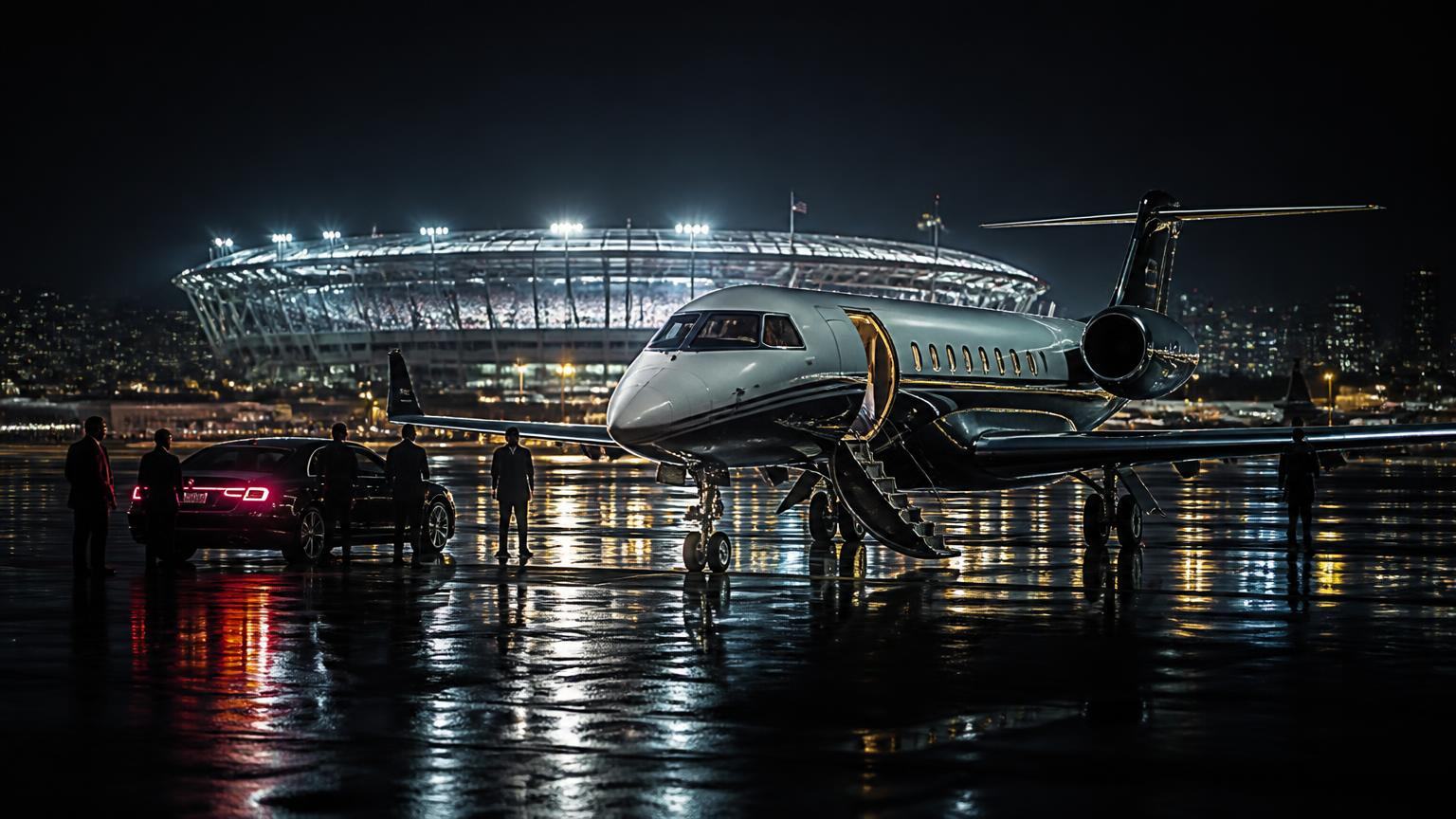
Private jet on the apron ahead of Ryder Cup in Rotating host course, Various

RYDER CUP · BIENNIAL

Ryder Cup

Private jet charter to Ryder Cup

ROTATING HOST COURSE, VARIOUSSEPTEMBER 2027 CYCLELEAD VALUE · HIGH

The Ryder Cup is the most corporate of the golf majors and the only one that reliably moves transatlantic traffic in volume, with American sponsors and supporters flying into a European host course every other cycle.

OPERATIONAL BRIEF

Ryder Cup at a glance

BEST AIRPORT
Host-course regional field (—)
BEST ALTERNATIVE
Transatlantic gateway (—)
PEAK PRESSURE
Arrivals compress the morning of day one; departures peak in the three hours after Ryder Cup closes
BOOK BY
Corporate blocks commit the host-region ramp a year ahead. Individual charters should be arranged at least three months out.
FASTEST TRANSFER
Chauffeur direct from the FBO apron
MAIN OPERATIONAL RISK
Slot pairs and aircraft parking at the primary gateway, plus road closures around the venue
BEST AIRCRAFT CLASS
Midsize
EMPTY-LEG LIKELIHOOD
Moderate probability either side of the event

Why charter for Ryder Cup

Three days of matches with a Sunday singles finish creates a long arrival window and a violently compressed departure. Host-region fields are usually regional airports without the ramp to hold that traffic across the weekend.

AIRPORT DECISION MATRIX

Which airport for Ryder Cup

AIRPORTROLERUNWAYAIRCRAFT ACCEPTEDTRANSFERSLOTSPARKINGCUSTOMS
Host-course regional field ()Default choice for Ryder Cup arrivalsPrimaryNot publishedConfirm aircraft acceptance with the handler before quotingClosest practical gateway to Rotating host course; chauffeur transfer direct from the FBOSlot pair + PPR required for the full event windowConstrained — expect drop-and-reposition from midweekOn-field customs and immigration during the event window
Transatlantic gateway ()Best backup when the primary field closes out on parkingAlternativeNot publishedConfirm aircraft acceptance with the handler before quotingSecondary field — confirm road transfer time with the desk before committingPPR advisable; slot pressure lower than the primary fieldLimited on peak days; book with the slotOn demand — confirm 24 h ahead for early or late movements

Runway and infrastructure data from the Limitless Sky airport intelligence catalogue. Transfer times are event-week planning figures, not normal-day estimates.

EVENT WEEK

What changes during September 2027 cycle

  • SLOT AVAILABILITY

    Host-course regional field moves to a slot-pair regime for September 2027 cycle. Arrival without a matched departure slot is refused, and the morning band on day one is the first to close.

  • AIRCRAFT PARKING

    Parking, not runway, is the binding constraint. From midweek, most aircraft drop passengers and reposition to a secondary field, then return for the departure slot. Budget the positioning legs into the quote.

  • HANDLING AND FBO CAPACITY

    FBO lounges, crew cars and hangarage sell out weeks ahead of Ryder Cup. Handling requests submitted inside 14 days are accepted on a best-effort basis only.

  • CREW ACCOMMODATION

    Hotel capacity in Rotating host course is consumed by the event itself, so crews are frequently housed one city away. That drives crew-duty planning and can make a same-evening departure impossible.

  • AIRPORT CHARGES

    Event-week handling, parking and slot-coordination fees rise materially against normal-season rates and are passed through at cost on our quotes.

  • ROAD ACCESS

    Closures and rolling restrictions around the venue mean a normal-day drive time is not a valid planning number during September 2027 cycle.

Pricing by aircraft category

CATEGORYPAXEXAMPLEFROM
Light jet4–6Citation CJ3, Phenom 300€8,500
Midsize7–8Citation XLS, Praetor 500€11,500
Super-midsize8–9Challenger 350, Praetor 600€15,500
Heavy10–14Falcon 2000, Falcon 7X€23,000
Ultra-long range14–18Gulfstream G650, Global 7500€48,000

Corporate blocks commit the host-region ramp a year ahead. Individual charters should be arranged at least three months out.

PRICING ASSUMPTIONS

What these prices do and do not include

  • Prices are one-way indicative ranges, not live inventory.
  • Assumes the passenger count shown in each row and standard luggage for Ryder Cup.
  • Aircraft category is stated per row; actual tail assignment is confirmed at contract.
  • Currency: EUR unless the row states otherwise.
  • Included: aircraft, crew, standard catering, landing and handling at the stated airports.
  • Excluded: de-icing, extended parking, overnight crew, event-week surcharges billed by the airport and any helicopter or ground transfer legs.
  • Positioning: assumes the aircraft is available in-region. Long positioning legs during the event window are quoted separately.
  • Event-week surcharges are not baked into the "from" figures — expect a premium on the September 2027 cycle window.

AIRCRAFT

Which aircraft for Ryder Cup

2–4 PASSENGERS, REGIONAL

Phenom 300E / Citation CJ3+

Cheapest way into the Rotating host course corridor and the class most likely to still find a slot late.

6–8 PASSENGERS, EUROPEAN LEGS

Challenger 350 / Praetor 600

Stand-up cabin with the range for London, Geneva, Milan or Madrid non-stop into Ryder Cup, and accepted at every gateway on the matrix.

10–14 PASSENGERS, GROUP OR DELEGATION

Falcon 2000LXS / Challenger 650

Keeps the party on one tail, which matters when slot pairs are the scarce resource rather than seats.

LONG-RANGE ARRIVAL

Gulfstream G650ER / Global 7500

Non-stop from North America, the Gulf or Asia into the primary gateway — the only fields on this page that accept them are the long-runway ones.

BOOKING TIMELINE

When to do what

  1. 90 DAYS BEFORE

    Request slot pairs, FBO handling, helicopter and chauffeur bookings together — not sequentially.

  2. 30 DAYS BEFORE

    Lock the passenger manifest, catering and luggage plan; confirm customs timing for early or late movements.

  3. 7 DAYS BEFORE

    Operational reconfirmation: slots, parking, crew duty, transfers and the contingency plan.

  4. 24 HOURS BEFORE

    Weather, NOTAMs, road closures, crew duty and transfer verification with the handling agent.

ARRIVAL PLAYBOOK

Wheels down to venue

  1. 01Arrive at Host-course regional field (—) on the confirmed slot.
  2. 02FBO and border formalities — typically 5–15 minutes on a private terminal, longer on peak arrival mornings.
  3. 03Aircraft-side transfer where the airport permits it; otherwise a short apron shuttle to the FBO.
  4. 04Chauffeur from the FBO on the pre-agreed routing, avoiding the closed roads around the venue.
  5. 05Arrive at the hotel, yacht or Ryder Cup venue.
  6. 06Total door-to-door on a normal day is materially shorter than during September 2027 cycle; plan the event-week version, not the Google Maps version.

DEPARTURE PLAYBOOK

The hard part of every event trip

The peak is the closing afternoon

The single heaviest movement of the Ryder Cup period is the three hours after the event finishes. Every operator wants the same band, and the airport cannot supply it.

Leaving immediately is usually not realistic

Unless your slot was reserved months ahead, a same-hour departure is a hope, not a plan. Build in a two-to-four hour buffer or accept an alternative field.

Should the aircraft wait or reposition?

Where parking is constrained, the aircraft drops and repositions, then returns for the departure slot. That adds two positioning legs but is frequently cheaper than paying event-week parking, and it is often the only way to hold a good departure time.

Crew duty

A late finish plus a delayed slot can push the crew out of duty, which cancels the departure entirely. We plan the crew day against the realistic departure, not the optimistic one.

Alternatives worth taking

Departing from Transatlantic gateway (—) instead of the primary field regularly saves more time than it costs in road transfer.

The morning-after option

Departing the next morning is the single most reliable improvement to an Ryder Cup itinerary: clear slots, rested crew, no closure traffic and lower handling pressure.

LAST MILE

Transfer options compared

MODENORMAL CONDITIONSEVENT WEEKNOTES
Chauffeured vehicleDirect, predictable, luggage stays with the passengerMaterially slower during September 2027 cycle — venue closures reroute trafficDefault option, and the fallback for every other mode on this list.
RailReliable where a station sits near the venueCrowded but unaffected by road closures — a genuine fallbackWorth holding for the departure day when road timing is the risk.
Restricted-zone accessNot applicableFinal approach to the Ryder Cup venue is frequently on foot or by accredited shuttle onlyPassengers should expect a short walk-in even on a fully chauffeured itinerary.

CONTINGENCY

What happens when the plan breaks

What if the preferred airport closes?
Every Ryder Cup trip is filed with Transatlantic gateway (—) as the nominated alternate, with a ground plan already priced. A closure changes the drive, not the trip.
What if aircraft parking is unavailable?
The aircraft drops passengers and repositions to a field with parking, returning for the departure slot. This is planned in advance, not improvised on the day.
What if the helicopter cannot fly?
Rotary is weather-dependent and is never the only plan. A chauffeur is held on standby for every helicopter leg, with the road timing already checked against the closure map.
What if Ryder Cup runs late?
Where the airport allows it we hold a provisional later slot on peak departure days, so an overrun moves the departure rather than cancelling it.
What if the aircraft becomes unavailable?
Operators are contracted with a recovery obligation, and we hold a named backup tail in the same class for event-week trips at tier-one events.
What if the weather changes?
The alternate, the fuel plan and the ground fallback are set before departure. On marginal days we brief the passenger before the aircraft leaves, not after it diverts.
What if the passenger changes departure time?
During September 2027 cycle a change is a re-request, not a reschedule — the original slot is released the moment it is given up. We quote the change window honestly before you commit.

EMPTY LEGS

Empty legs around Ryder Cup

Moderate probability either side of the event. Ryder Cup does not saturate the Rotating host course corridor, so empty legs remain realistic before and after the event window. Core dates still tighten sharply.

See live empty legs and set a corridor alert →

VIP itinerary notes

Hospitality is sold through the Ryder Cup's official programmes and sponsors. American clients typically clear customs at a major gateway and fly the last sector domestically to keep the host-field arrival simple.

Ryder Cup private jet demand — airports & surge windows

Which nearby airports absorb the traffic, when arrivals and departures compress, logistics FAQ and empty-leg corridors.

VIEW DEMAND →

CHARTER GUIDE

Private jet charter to Ryder Cup: the complete September 2027 cycle guide

Ryder Cup runs September 2027 cycle in Rotating host course, Various, and it is one of the fixtures where private aviation stops being a convenience and becomes the only workable way in and out. The Ryder Cup is the most corporate of the golf majors and the only one that reliably moves transatlantic traffic in volume, with American sponsors and supporters flying into a European host course every other cycle.

This guide covers everything a charter client needs before committing: which airports actually work during the event window, how slot and parking rules change once the fixture starts, what a one-way charter costs by aircraft category, when to book, how ground transfers behave under event-week load, and what happens if weather or a schedule change breaks the plan. Every figure below is specific to Ryder Cup rather than a generic Various average.

If you already know your dates and passenger count, the fastest route is a direct enquiry — our charter desk holds live availability across Host-course regional field (—) and Transatlantic gateway (—) and the wider Rotating host course catchment, and will come back with aircraft options, firm pricing and a slot assessment rather than an indicative range.

Why fly privately to Ryder Cup

Three days of matches with a Sunday singles finish creates a long arrival window and a violently compressed departure. Host-region fields are usually regional airports without the ramp to hold that traffic across the weekend.

Scheduled capacity into Rotating host course does not flex for a single week in the calendar. Airlines add marginal seats at best, fares on the surviving inventory move sharply, and connection risk rises exactly when the itinerary has no slack. A charter removes the three failure points that matter: you choose the departure time, you choose the airport, and you are not exposed to somebody else's misconnection. For groups the arithmetic also changes — once four to six people travel together, the per-seat gap between business class and a light jet narrows to the point where the private option is defensible on cost alone, before any value is placed on the time recovered.

The second argument is proximity. Commercial traffic concentrates on the main hub; business aviation can use Transatlantic gateway (—) and land materially closer to where the event actually happens, converting an airport transfer from a variable into a fixed, short, controllable leg.

Best airports for Ryder Cup — Rotating host course decision matrix

Rotating host course presents a small number of realistic options during Ryder Cup, and the ranking changes during the event week. The airports below are the ones our operations desk actually files to.

Host-course regional field (—) — primary. Confirm aircraft acceptance with the handler before quoting Runway: Not published. Transfer to the event: Closest practical gateway to Rotating host course; chauffeur transfer direct from the FBO. Slots: Slot pair + PPR required for the full event window Parking: Constrained — expect drop-and-reposition from midweek Customs and immigration: On-field customs and immigration during the event window Default choice for Ryder Cup arrivals 20–45 minutes from the course; parking allocated months ahead for the week.

Transatlantic gateway (—) — alternative. Confirm aircraft acceptance with the handler before quoting Runway: Not published. Transfer to the event: Secondary field — confirm road transfer time with the desk before committing. Slots: PPR advisable; slot pressure lower than the primary field Parking: Limited on peak days; book with the slot Customs and immigration: On demand — confirm 24 h ahead for early or late movements Best backup when the primary field closes out on parking Full customs for US inbound legs, with the last sector flown domestically.

The practical rule for Ryder Cup: file for the primary field first, hold a named alternate on the trip sheet, and accept a slightly longer drive in exchange for a guaranteed parking stand. Aircraft that arrive without a confirmed stand are the ones that end up repositioning empty to a field an hour away, which adds cost and — more importantly — adds a second crew duty consideration on the outbound.

What changes at Rotating host course airports during Ryder Cup

Outside the event window, Rotating host course handling is routine. Inside it, four things change simultaneously: slot allocation moves to a coordinated or prior-permission regime, parking becomes the binding constraint rather than runway capacity, handling and FBO lounge throughput slows, and ground transfer times inflate because the same road network is carrying event traffic.

Slot availability. Host-course regional field moves to a slot-pair regime for September 2027 cycle. Arrival without a matched departure slot is refused, and the morning band on day one is the first to close.

Aircraft parking. Parking, not runway, is the binding constraint. From midweek, most aircraft drop passengers and reposition to a secondary field, then return for the departure slot. Budget the positioning legs into the quote.

Handling and FBO capacity. FBO lounges, crew cars and hangarage sell out weeks ahead of Ryder Cup. Handling requests submitted inside 14 days are accepted on a best-effort basis only.

Crew accommodation. Hotel capacity in Rotating host course is consumed by the event itself, so crews are frequently housed one city away. That drives crew-duty planning and can make a same-evening departure impossible.

Airport charges. Event-week handling, parking and slot-coordination fees rise materially against normal-season rates and are passed through at cost on our quotes.

Road access. Closures and rolling restrictions around the venue mean a normal-day drive time is not a valid planning number during September 2027 cycle.

None of this is a reason to avoid flying privately; it is a reason to plan earlier. Every constraint above is solvable with lead time and unsolvable without it.

Ryder Cup private jet charter cost by aircraft category

Charter pricing for Ryder Cup is quoted per aircraft, one way, not per seat. The indicative floors below assume a standard positioning leg, normal crew duty and no overnight stand at the event field.

A light jet (Citation CJ3, Phenom 300, 4–6 passengers) starts from €8,500 on the short regional pairings most clients use. At the other end, ultra-long range lift (Gulfstream G650, Global 7500, 14–18 passengers) starts from €48,000 and is the category to look at when the group is travelling intercontinentally or wants a full cabin service on board.

What moves those numbers for this event: prices are one-way indicative ranges, not live inventory, assumes the passenger count shown in each row and standard luggage for ryder cup, aircraft category is stated per row; actual tail assignment is confirmed at contract, currency: eur unless the row states otherwise, included: aircraft, crew, standard catering, landing and handling at the stated airports, excluded: de-icing, extended parking, overnight crew, event-week surcharges billed by the airport and any helicopter or ground transfer legs, positioning: assumes the aircraft is available in-region. long positioning legs during the event window are quoted separately and event-week surcharges are not baked into the "from" figures — expect a premium on the september 2027 cycle window.

Two structural costs are specific to event weeks. The first is repositioning: if the aircraft cannot hold a stand at the arrival field, the operator flies it empty to a nearby base and back, and that flying is billed. The second is crew — an overnight at the event city during peak week costs more, and duty limits sometimes force a second crew rather than a wait. Both are quantifiable in advance; neither should appear as a surprise on the invoice.

The cheapest Ryder Cup charters are almost always the ones booked early enough that the aircraft is already in the region, and empty-leg repositioning flights around the event window can cut the figure substantially for clients whose timing is flexible.

Which aircraft to charter for Ryder Cup

Aircraft selection for this event is driven by mission, not by prestige. The right answer is the smallest type that clears the runway, the range and the baggage requirement with margin.

2–4 passengers, regional — Phenom 300E / Citation CJ3+. Cheapest way into the Rotating host course corridor and the class most likely to still find a slot late.

6–8 passengers, European legs — Challenger 350 / Praetor 600. Stand-up cabin with the range for London, Geneva, Milan or Madrid non-stop into Ryder Cup, and accepted at every gateway on the matrix.

10–14 passengers, group or delegation — Falcon 2000LXS / Challenger 650. Keeps the party on one tail, which matters when slot pairs are the scarce resource rather than seats.

Long-range arrival — Gulfstream G650ER / Global 7500. Non-stop from North America, the Gulf or Asia into the primary gateway — the only fields on this page that accept them are the long-runway ones.

Where the group is close to a category boundary, step up rather than down. A marginally larger cabin costs a defined amount; a tech stop or a baggage offload on the morning of the event costs the itinerary.

When to book your Ryder Cup charter

Corporate blocks commit the host-region ramp a year ahead. Individual charters should be arranged at least three months out.

90 days before. Request slot pairs, FBO handling, helicopter and chauffeur bookings together — not sequentially.

30 days before. Lock the passenger manifest, catering and luggage plan; confirm customs timing for early or late movements.

7 days before. Operational reconfirmation: slots, parking, crew duty, transfers and the contingency plan.

24 hours before. Weather, NOTAMs, road closures, crew duty and transfer verification with the handling agent.

Late enquiries are not impossible — we place aircraft inside 24 hours regularly — but late means accepting whatever combination of airport, aircraft and slot remains, and the price reflects scarcity rather than the market.

Arrival playbook: wheels down to Ryder Cup

The arrival sequence at Rotating host course during the event is short, but it only stays short if the ground side is arranged before departure.

Arrive at Host-course regional field (—) on the confirmed slot.

FBO and border formalities — typically 5–15 minutes on a private terminal, longer on peak arrival mornings.

Aircraft-side transfer where the airport permits it; otherwise a short apron shuttle to the FBO.

Chauffeur from the FBO on the pre-agreed routing, avoiding the closed roads around the venue.

Arrive at the hotel, yacht or Ryder Cup venue.

Total door-to-door on a normal day is materially shorter than during September 2027 cycle; plan the event-week version, not the Google Maps version.

Expect terminal-side formalities to take minutes rather than the hour a commercial arrival consumes, provided documentation was filed with the handler in advance and the transfer is already positioned.

Departure playbook: leaving Rotating host course after Ryder Cup

Departure, not arrival, is where event weeks go wrong. Everyone leaves inside the same four-hour window, so the constraint moves from parking to departure slots and ground handling throughput.

The peak is the closing afternoon. The single heaviest movement of the Ryder Cup period is the three hours after the event finishes. Every operator wants the same band, and the airport cannot supply it.

Leaving immediately is usually not realistic. Unless your slot was reserved months ahead, a same-hour departure is a hope, not a plan. Build in a two-to-four hour buffer or accept an alternative field.

Should the aircraft wait or reposition?. Where parking is constrained, the aircraft drops and repositions, then returns for the departure slot. That adds two positioning legs but is frequently cheaper than paying event-week parking, and it is often the only way to hold a good departure time.

Crew duty. A late finish plus a delayed slot can push the crew out of duty, which cancels the departure entirely. We plan the crew day against the realistic departure, not the optimistic one.

Alternatives worth taking. Departing from Transatlantic gateway (—) instead of the primary field regularly saves more time than it costs in road transfer.

The morning-after option. Departing the next morning is the single most reliable improvement to an Ryder Cup itinerary: clear slots, rested crew, no closure traffic and lower handling pressure.

Ground transfers in Rotating host course during Ryder Cup

Airport-to-venue timings shift materially once the event starts. Plan against event-week numbers, not the map estimate.

Chauffeured vehicle. Normally Direct, predictable, luggage stays with the passenger; during the event Materially slower during September 2027 cycle — venue closures reroute traffic. Default option, and the fallback for every other mode on this list.

Rail. Normally Reliable where a station sits near the venue; during the event Crowded but unaffected by road closures — a genuine fallback. Worth holding for the departure day when road timing is the risk.

Restricted-zone access. Normally Not applicable; during the event Final approach to the Ryder Cup venue is frequently on foot or by accredited shuttle only. Passengers should expect a short walk-in even on a fully chauffeured itinerary.

Where a helicopter shuttle exists it is usually the difference between a predictable transfer and an unpredictable one, and it should be booked at the same time as the aircraft rather than on arrival.

Empty leg flights to Rotating host course around Ryder Cup

Moderate probability either side of the event Ryder Cup does not saturate the Rotating host course corridor, so empty legs remain realistic before and after the event window. Core dates still tighten sharply.

An empty leg is a repositioning flight the operator has to make anyway, offered at a discount because the aircraft would otherwise fly without passengers. Around Ryder Cup the density of these flights spikes: aircraft that drop passengers before the event have to leave, and aircraft coming to collect passengers after it have to arrive. The trade-off is control — you accept the operator's timing and airport, and the flight can be cancelled if the underlying charter changes. For clients with one flexible leg, typically the outbound, the saving is real and worth registering for.

Contingency planning for Ryder Cup

Every Ryder Cup trip sheet we build carries a named alternate, a defined weather minimum and a nominated recovery airport. These are the scenarios that actually occur:

What if the preferred airport closes? Every Ryder Cup trip is filed with Transatlantic gateway (—) as the nominated alternate, with a ground plan already priced. A closure changes the drive, not the trip.

What if aircraft parking is unavailable? The aircraft drops passengers and repositions to a field with parking, returning for the departure slot. This is planned in advance, not improvised on the day.

What if the helicopter cannot fly? Rotary is weather-dependent and is never the only plan. A chauffeur is held on standby for every helicopter leg, with the road timing already checked against the closure map.

What if Ryder Cup runs late? Where the airport allows it we hold a provisional later slot on peak departure days, so an overrun moves the departure rather than cancelling it.

What if the aircraft becomes unavailable? Operators are contracted with a recovery obligation, and we hold a named backup tail in the same class for event-week trips at tier-one events.

What if the weather changes? The alternate, the fuel plan and the ground fallback are set before departure. On marginal days we brief the passenger before the aircraft leaves, not after it diverts.

What if the passenger changes departure time? During September 2027 cycle a change is a re-request, not a reschedule — the original slot is released the moment it is given up. We quote the change window honestly before you commit.

VIP, security and privacy notes for Ryder Cup

Hospitality is sold through the Ryder Cup's official programmes and sponsors. American clients typically clear customs at a major gateway and fly the last sector domestically to keep the host-field arrival simple.

Where discretion is a requirement rather than a preference, the levers are the airport choice, the handler, and the timing of arrival relative to the peak wave. Smaller fields with a single dedicated FBO give more control over who is on the ramp than a large coordinated airport running a temporary event apron.

How to charter a private jet to Ryder Cup

Send the route, the dates, the passenger count and any baggage that is out of the ordinary. Our desk returns aircraft options with firm pricing, the airport recommendation for your specific timing, a slot and parking assessment, and the ground transfer plan — normally within the hour during working days.

We are broker-side, which means we are not selling one operator's fleet. Every aircraft offered for Ryder Cup is checked for operator certification, insurance and event-field suitability before it reaches you, and the airport recommendation is made on operational grounds rather than on which handler pays a commission.

If dates are still moving, say so in the enquiry: flexible timing around September 2027 cycle is the single largest lever on price, and it is the one that unlocks repositioning and empty-leg pricing.

FAQ

Why is the Ryder Cup harder to plan than a regular major?
It combines transatlantic arrivals with a small host-region airport and a Sunday singles finish that empties the course in two hours. Corporate blocks take much of the ramp a year ahead.
How should US clients route in?
Clear customs at a major European gateway and fly the final sector domestically. That avoids international handling at a regional field with limited customs hours.
What does it cost?
From about €8,500 per sector on a light jet within Europe and €23,000 on a heavy, with transatlantic legs on ultra-long-range aircraft from roughly €48,000.

OTHER LUXURY EVENTS

RELATED EVENTS

Other events with the same operating pattern

KNOWLEDGE GRAPH

Ryder Cup in the Limitless Sky knowledge graph

Airports, destinations, charter corridors, aircraft and related events connected to this event.

VERIFICATION

How this page is maintained

FACTS CHECKED
Reviewed against operator and handling-agent guidance for the current event cycle
DATES CONFIRMED
September 2027 cycle
PRICES REVIEWED
Indicative ranges reviewed against live charter quotes for the corridor
REVIEWED BY
Limitless Sky charter desk
CONFIDENCE
Moderate — reviewed on the standard event cycle
NEXT REVIEW
6 and 1 month before the event, then 7 days out

Sources

  • · Airport and handling-agent operational notices for the event window
  • · Official event organiser schedule and venue access guidance
  • · Limitless Sky operator quote data for the corridors shown
  • · Airport runway and infrastructure records held in the Limitless Sky airport intelligence catalogue
Book HereDo you have a question?