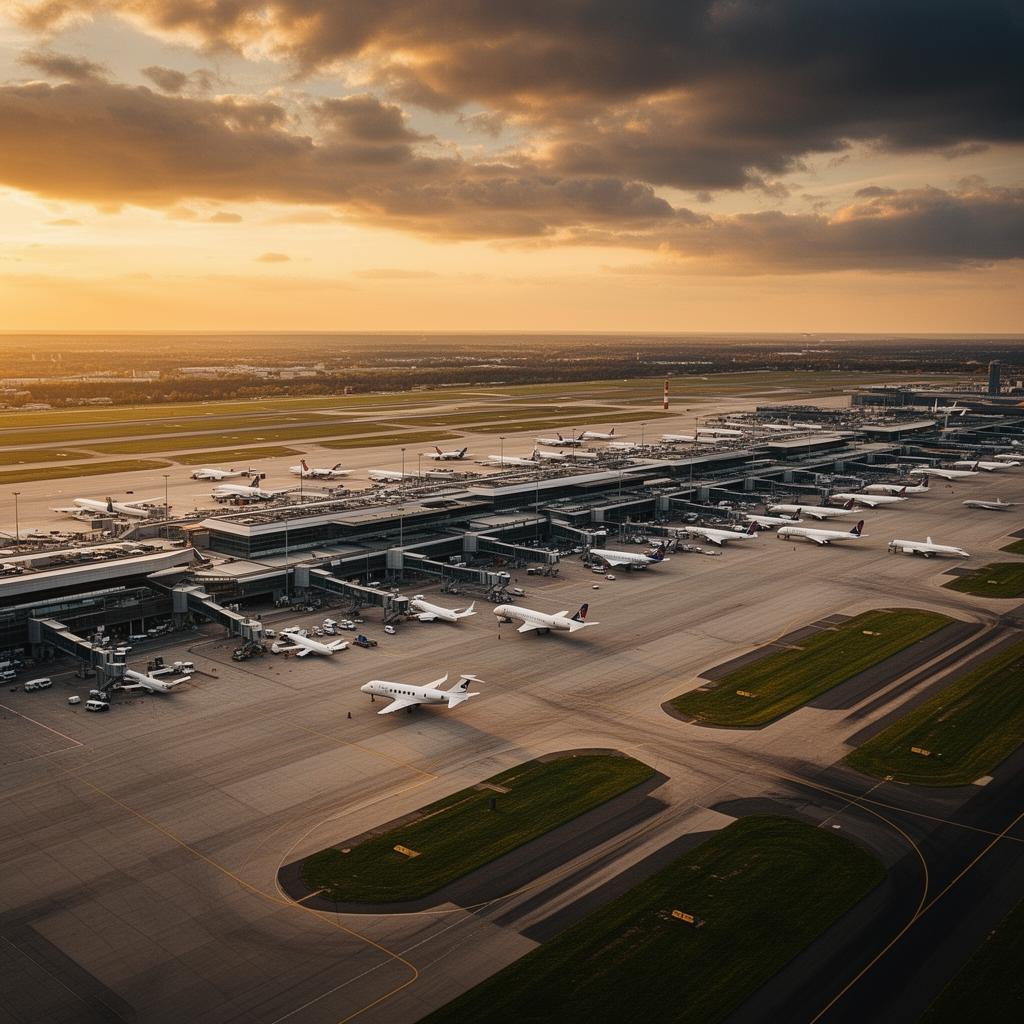
Europe is home to some of the busiest airports in the world, showcasing a blend of modernity and tradition. These hubs connect continents, facilitate commerce, and serve as the entry point for millions of leisure travellers every year. For those who value time and discretion, however, the same infrastructure that makes these airports powerful also makes them congested — and that is where private aviation offers a compelling alternative.
London Heathrow: Europe's busiest gateway
London Heathrow Airport leads European traffic, handling over 79 million passengers in 2023. As the primary hub for transatlantic travel and a fortress for British Airways and Virgin Atlantic, Heathrow operates at capacity for much of the year. Terminal 5 remains the benchmark for commercial airport design, but the volume means security queues, taxi delays and slot restrictions are a constant reality. For private jet travellers, London City (LCY), Farnborough (FAB) and Biggin Hill (BQH) offer dramatically faster alternatives — 15-minute arrivals, no main-terminal congestion, and helicopter transfers into central London in under 12 minutes.
Istanbul Airport: the cross-continental bridge
Istanbul Airport has risen rapidly to become one of Europe's largest hubs, designed from the ground up to handle 200 million passengers annually at full build-out. Its position straddling Europe and Asia makes it indispensable for routes into the Middle East, Central Asia and the Far East. The architecture is spectacular — but so are the walking distances. Private jet users typically prefer Atatürk's legacy general aviation facilities or Istanbul's dedicated business aviation terminal, where Turkish hospitality and efficient handling keep ground time to a minimum.
Paris Charles de Gaulle & Amsterdam Schiphol
Paris Charles de Gaulle (CDG) and Amsterdam Schiphol (AMS) are the twin pillars of North European aviation. CDG serves as Air France-KLM's long-haul hub, while Schiphol's single-terminal design and KLM's network make it one of the most efficient large airports in the world. Both, however, suffer from peak-hour congestion and ongoing slot constraints. For private travellers, Paris-Le Bourget (LBG) — Europe's busiest business aviation airport — and Amsterdam's dedicated General Aviation Terminal offer a completely different experience: private lounges, apron-side boarding, and departures in under 15 minutes from arrival at the FBO.
Madrid, Frankfurt, Barcelona, Rome and Munich
Beyond the top tier, a cluster of major European airports each plays a distinct role. Madrid-Barajas (MAD) is the critical juncture for Latin American traffic, with Iberia's hub feeding direct routes to Buenos Aires, Mexico City and São Paulo. Frankfurt (FRA) remains the continent's cargo and business-travel powerhouse — the airport of choice for corporate road-warriors and international finance. Barcelona-El Prat (BCN) and Rome Fiumicino (FCO) are primarily tourism-driven, peaking in summer as Mediterranean holiday traffic surges. Munich (MUC) rounds out the list with Lufthansa's premium hub and some of the most consistent on-time performance in Europe.
For private jet travellers, each of these cities offers dedicated FBO alternatives: Madrid Cuatro Vientos, Frankfurt Egelsbach (for smaller aircraft), Barcelona's General Aviation Terminal, Rome Ciampino (CIA) — the original gateway now reserved for private and state aviation — and Munich's Business Aviation Terminal. The common thread is simple: bypass the main terminal, reclaim the time, and arrive closer to your final destination.
Why these airports are so busy
These airports are busy because they connect the world. They sit at the centre of major city economies, serve as hubs for global airline alliances, and handle the densest long-haul route networks on the planet. Business travel, tourism, cargo and connecting traffic all converge in the same facilities. The result is infrastructure under constant pressure — runways at capacity, terminals nearing design limits, and passenger numbers that rebound quickly after any downturn. For commercial aviation, this density is a sign of health. For the individual traveller, it is increasingly a source of friction.
How airport congestion impacts the travel experience
Busy airports lead to longer wait times, crowded terminals, and the omnipresent risk of delays. Security queues at Heathrow and Frankfurt routinely exceed 45 minutes in peak season. Boarding and deplaning at mega-hubs involves walking distances that can top a kilometre. Baggage handling at volume airports faces more stress, and the sheer number of passengers creates a relentless ambient pressure. For families, business travellers on tight schedules, or anyone simply seeking a calmer start to a trip, the commercial terminal experience at Europe's busiest airports is increasingly something to be endured rather than enjoyed.
The private jet alternative
Private jet charters transform the experience of travelling through or near Europe's busiest airports. Instead of navigating crowded terminals, travellers use dedicated FBOs — private terminals with their own lounges, customs and security. Boarding takes minutes, not hours. Aircraft can use smaller airfields closer to final destinations, cutting ground transfer times dramatically. And the in-flight experience is tailored: specific catering, preferred seating configurations, and the privacy to work or rest without interruption.
For travel to London, Paris, Amsterdam, Munich or the Mediterranean, private aviation is not merely a luxury — it is a practical recalibration of the time and energy a trip consumes. At Limitless Sky, we specialise in positioning the right aircraft for every European corridor, with instant quotes, empty-leg savings and 24/7 support that keeps the journey as smooth as the destination.
Frequently asked questions
What are the busiest airports in Europe?
The busiest airports in Europe include London Heathrow, Istanbul Airport, Paris Charles de Gaulle, Amsterdam Schiphol, Madrid-Barajas, Frankfurt, Barcelona-El Prat, Rome Fiumicino and Munich — each handling tens of millions of passengers annually.
Why are these airports so busy?
They connect extensive international flight networks, are located in major global cities, and serve as critical hubs for business travel, tourism and cargo logistics.
How does airport traffic impact the travel experience?
High passenger volumes can lead to longer security queues, crowded terminals, extended walking distances and an increased likelihood of delays.
Are there specific challenges at busy airports?
Yes — security processing, baggage handling, passenger flow management and slot restrictions all create friction, particularly during peak summer and holiday seasons.
Can I find various amenities at these airports?
Absolutely. Most major airports offer extensive retail, dining, lounges and concierge services. The finest amenities, however, are typically found in the private FBO terminals used by business aviation.
TL;DR — Europe's busiest airports — led by London Heathrow, Istanbul and Paris CDG — are essential global hubs, but their scale brings congestion and delays. Private jet charters offer a direct alternative: private terminals, faster boarding, smaller airfields and a fully personalised travel experience. For effortless access to Europe's major cities, explore charter options at Limitless Sky.


