Cirrus Vision Jet SF50 private jet charter

Cirrus Vision Jet SF50 Charter

The world's only single-engine personal jet with whole-airframe parachute.

PAX5RANGE1,275 nmSPEEDMach 0.53BAGGAGE30 cu ftCABIN4'1" × 5'1"TYPICALLondon → Manchester · from £2,800

OVERVIEW

Cirrus Vision Jet SF50

The Cirrus Vision Jet SF50 is the world's only single-engine personal jet, with a unique CAPS whole-airframe parachute system. Five passengers, panoramic windows and a pressurised cabin make it ideal for short owner-pilot or charter missions.

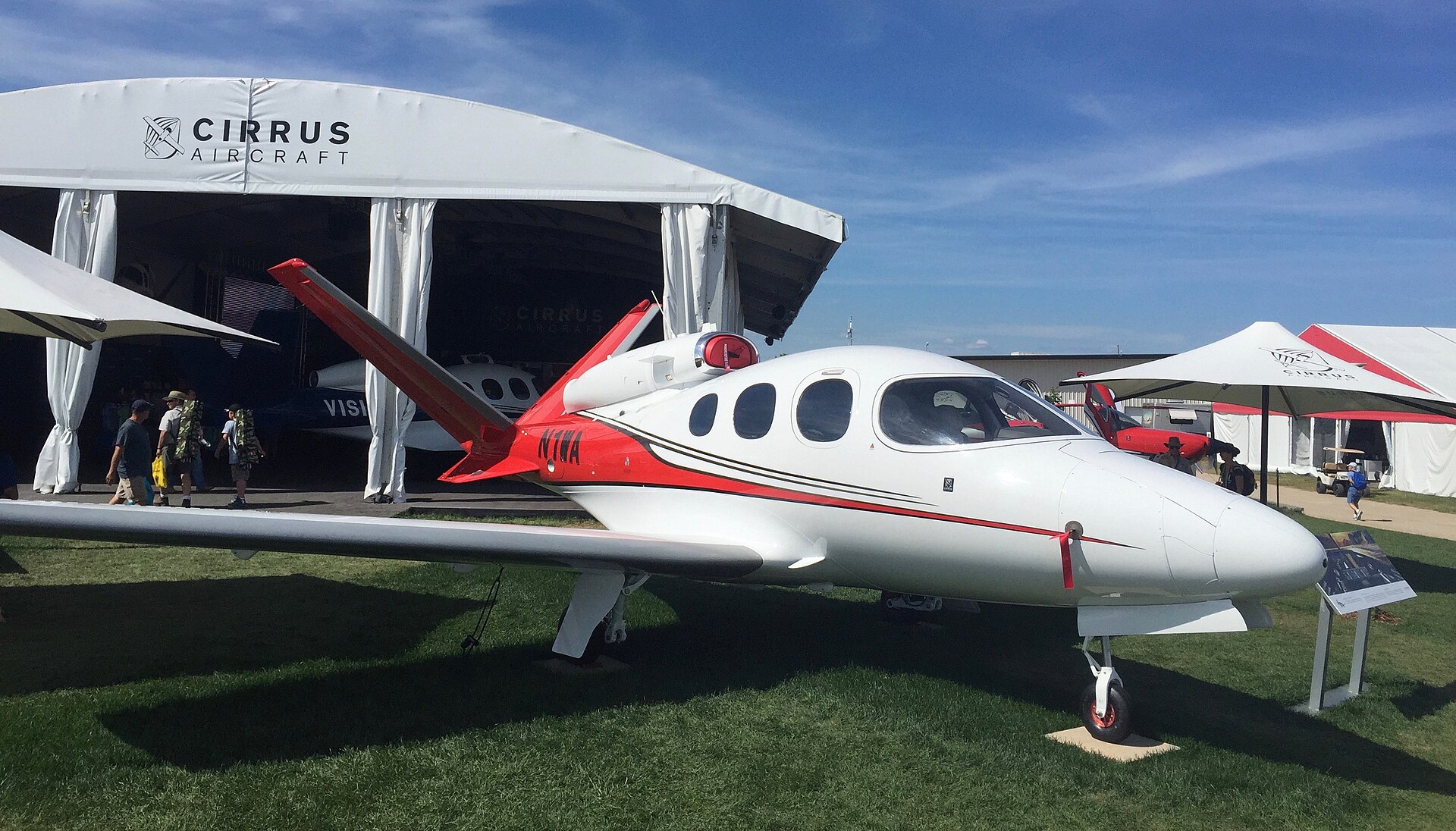
Cirrus Vision SF50 at EAA AirVenture Oshkosh 2016

IN DEPTH

The complete guide to chartering the Cirrus Vision Jet SF50

The story behind the Cirrus Vision Jet

The Cirrus Vision Jet SF50 is the aircraft that nobody in the industry thought could be built, then nobody thought would sell, and now nobody in the very light jet category can quite figure out how to compete with. Cirrus Aircraft — the Duluth, Minnesota manufacturer best known for the SR20 and SR22 piston singles that carry a whole-airframe ballistic parachute — announced its intention to build a single-engine personal jet in 2006. The programme survived a Chinese ownership change, a global recession and a series of certification delays before the FAA finally awarded type certificate A00030CH in October 2016. It became the first single-engine civil jet ever certified for commercial charter operations.

Nine years and more than 550 deliveries later, the Vision Jet is the best-selling jet aircraft in the world by unit volume, has been named Robert J. Collier Trophy winner and has quietly reshaped the entry-level jet market. The current G2+ variant, introduced in 2021, added the Williams FJ33-5A engine variant with digital engine control, an updated Garmin Perspective Touch+ avionics suite, wireless charging and a series of interior refinements. The G2+ is what almost every charter operator flies today.

The Vision Jet's most distinctive feature — the whole-airframe Cirrus Airframe Parachute System (CAPS) — is not a marketing gimmick. It is a certified emergency system that, if deployed within its envelope, brings the entire aircraft down under a canopy at a survivable rate of descent. As of 2024, CAPS has been credited with saving more than 240 lives across the Cirrus fleet. In a single-engine jet used for personal and light commercial operations, the psychological and actuarial value of that system is difficult to overstate.
On board: the Vision Jet cabin

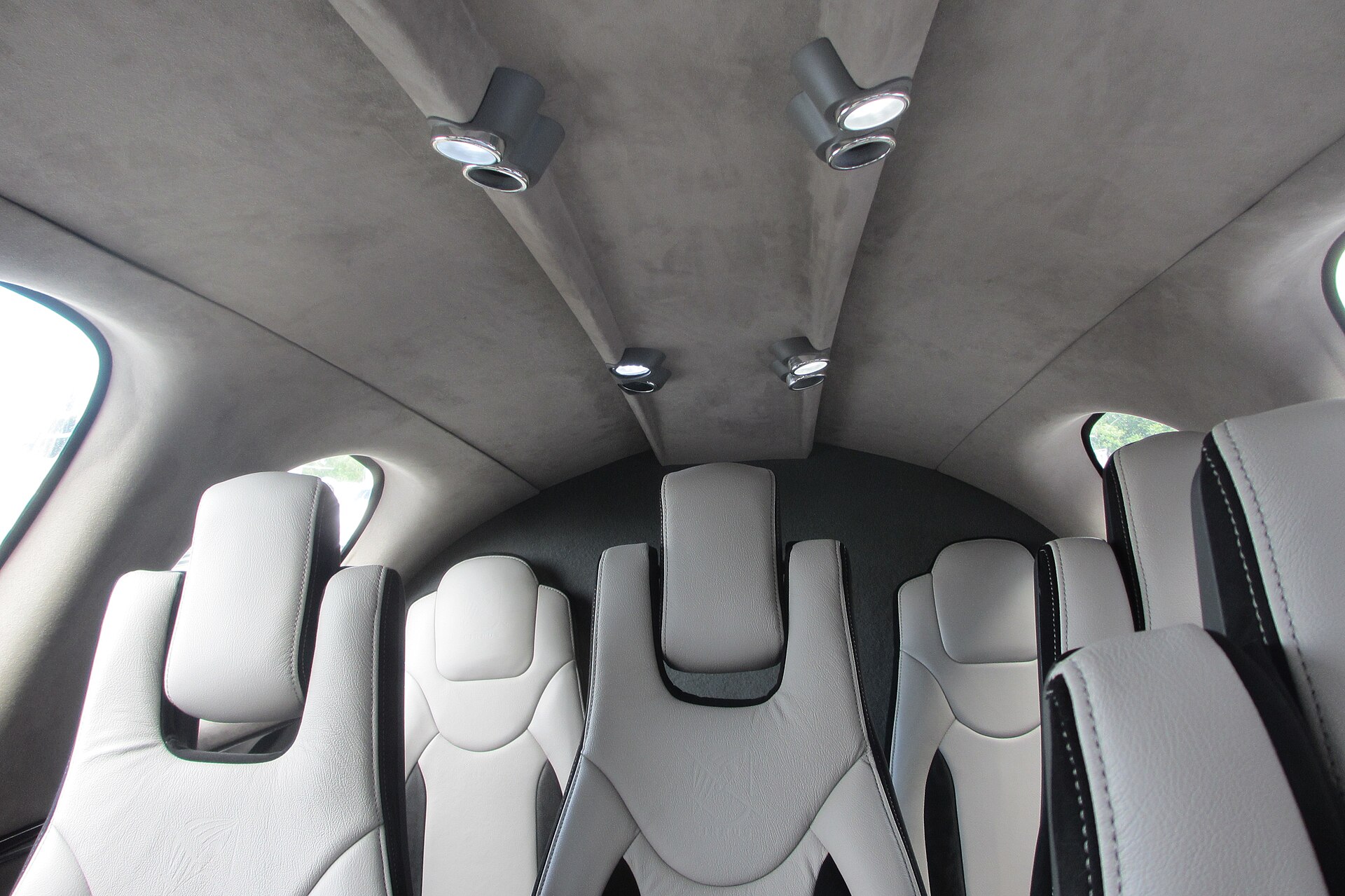
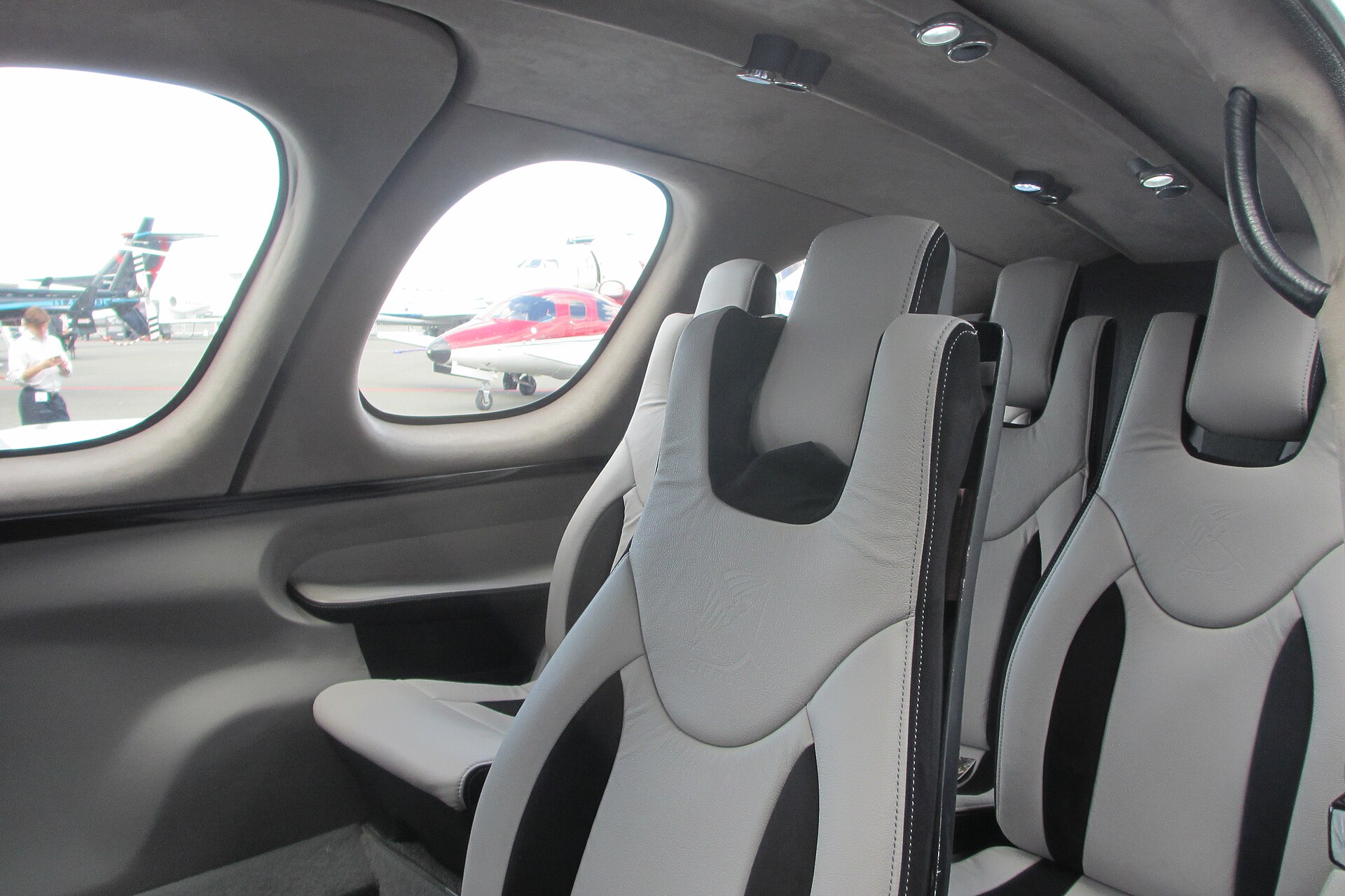
The Vision Jet's cabin is unlike any other jet's — literally. The distinctive V-tail, the raised engine pod, and the near-complete absence of a conventional flight-deck bulkhead give the interior a lightness and openness that has more in common with a high-end SUV than a traditional turbofan. There are no separate cockpit and cabin: the two pilot seats and the passenger seats form a single continuous cabin, with panoramic side windows that run virtually the full length of the fuselage and a windscreen that gives back-seat passengers a genuine forward view.

Standard configuration is five plus two: two pilot seats forward, three second-row seats (a middle seat that removes to accommodate additional legroom) and two third-row jump seats sized for children or a small adult on short sectors. Most charter configurations remove the third row and fly with a "four adults or two adults plus three children" layout. Seat materials on the G2+ are premium leather with Alcantara accents, and the interior colour palettes — five different Executive schemes ranging from clean Scandinavian light woods to dark walnut and carbon — are chosen at order.

Practical comfort details: full climate control with individual passenger vents, USB and 110V outlets at every seat, wireless-charging pads on the G2+, a lightweight galley cabinet forward-right that stows drinks and snacks, and a small aft lavatory (a "privacy area" more than a proper lav on shorter flights). Baggage volume totals 34 cubic feet across a nose locker and a small aft compartment — enough for four soft-sided weekend bags but not for skis or golf. Cabin altitude at FL310 is a comfortable 8,000 ft; the cabin is quiet enough on the ground and in cruise for normal conversation without headsets.

The Perspective Touch+ flight deck itself is the interior's most striking feature: three enormous touchscreen displays, autothrottle, synthetic vision, ADS-B In, and Garmin's Autoland system — a genuinely certified system that, at the push of a single red button, will identify the nearest suitable airport, plan and fly a full instrument approach, and land the aircraft with no pilot input. For a personal jet operating single-pilot, that is a category-defining safety feature.

Performance, range and runway access

The Vision Jet is powered by a single Williams FJ33-5A turbofan producing 1,846 lbf of thrust. Maximum cruise is 311 knots true airspeed, and normal cruise sits at 300 knots — meaningfully slower than the twin-engine HondaJet or Phenom 100EV, but roughly 100 knots faster than the fastest turboprop and, more importantly, above the weather at up to FL310. NBAA IFR range with the "Executive four" passenger load is 1,275 nautical miles, opening most European and US regional missions on a non-stop basis.

Practical mission examples: London Farnborough to Nice (620 nm, about 2h 15m), London to Palma de Mallorca (830 nm, about 3h), Paris Le Bourget to Marrakech (1,180 nm, near maximum range), Miami to Nassau or Havana (190/240 nm, well within short-hop economics), Los Angeles to Aspen (700 nm, 2h 30m). Longer sectors — London to Athens, London to the Canaries — will require a fuel stop, and any transatlantic routing is outside the Vision Jet's operational envelope.

Take-off field length at maximum weight is 2,036 ft; landing distance is 1,628 ft. These are the shortest figures of any jet on the charter market — meaningfully shorter than the CJ family, the Phenom 100, the HondaJet or the Learjets, and comparable to a turboprop. That opens a genuine long list of airports that no other jet can reach: London Denham (subject to noise), Sywell, Popham, Duxford (with prior permission), Courchevel-adjacent alternates, Sion, Elstree, Lydd, and dozens of smaller US strips. Fuel burn is exceptional at approximately 65 US gallons per hour in cruise — half the Phenom 100, a third of the CJ3+.

The single-engine architecture, whilst insurance-industry proven safe within its operating envelope, does mean the Vision Jet is not approved for Extended Overwater Operations without appropriate liferaft-and-vest equipment fits, and is generally flown along coastal or over-land routing where possible. In practice, this constrains very few European missions and none within the continental US.

Signature missions and best routes

Three mission profiles suit the Vision Jet perfectly. The first is one-to-two-person short hops where turboprop economics matter but a jet's speed and cabin quality are still desirable: London Farnborough to Amsterdam or Paris; Milan to Nice; Munich to Zurich; Miami to the Bahamas; Los Angeles to Las Vegas or San Francisco. On these routes, per-seat cost sits closer to a turboprop than a twin-jet whilst delivering a materially better cabin experience.

The second is small-family leisure travel to secondary airfields inaccessible to larger jets: the Vision Jet lands at Sion, Popham, Denham, Lydd, Nantucket and dozens of European sport airfields that no other jet can consider. This is where the ability to arrive within a five-minute drive of the destination — rather than a 40-minute road transfer — genuinely transforms the trip.

The third is the pilot-owner mission profile that dominates unit sales: an owner-operator flying single-pilot with family, using the CAPS parachute and Garmin Autoland as reassurance for spouses and children less comfortable with light aircraft. Whilst this is not directly a charter proposition, the sheer volume of pilot-owner Vision Jets creates a healthy charter fleet with well-maintained airframes and highly experienced type-rated crews.

Operating economics and charter pricing

Direct operating cost is genuinely low — approximately $850–$1,100 per flight hour excluding capital, roughly half the CJ3+ and one-third of a Phenom 300. That translates to charter hourly rates typically quoted at $2,400–$3,200 in North America and €2,600–€3,400 in Europe. On a per-passenger-mile basis for one to three passengers, the Vision Jet is genuinely competitive with commercial business class once total door-to-door time is included.

Indicative all-inclusive one-way pricing: London Farnborough to Nice from £5,900; London to Amsterdam from £3,800; London to Palma de Mallorca from £8,900; Miami to Nassau from $3,400; Los Angeles to Las Vegas from $4,200; Teterboro to Nantucket from $4,900. These figures are frequently below what a HondaJet Elite II or Phenom 100EV would price at, and dramatically below CJ3+ or Phenom 300 pricing for the same city-pair.

The trade-offs to understand: the Vision Jet's fleet in commercial charter is smaller than the established CitationJet or Phenom fleets, so short-notice availability can be tighter, particularly for weekend leisure departures from continental Europe. Positioning costs can also be higher because the Vision Jet's home base is more concentrated around specific operator hubs. Limitless Sky's operator relationships include Vision Jet fleets in the UK, France, Germany, Switzerland and the US — for pre-planned flexible bookings the aircraft's value proposition is one of the strongest in the industry.

How the Vision Jet compares

The Vision Jet's most direct competitors are the HondaJet Elite II and the Phenom 100EV. The HondaJet is faster (422 vs 311 knots), longer-legged (1,547 vs 1,275 nm) and twin-engine, but costs roughly 40–60% more per flight hour and requires longer runways. The Phenom 100EV sits similarly — faster and twin-engine, but more expensive and less capable at short strips. For any mission over 1,200 nm or into groups of five-plus, the HondaJet or Phenom win comfortably; for one to three passengers on shorter sectors requiring genuine short-field access, the Vision Jet is often the smarter answer.

Against high-end turboprops like the Pilatus PC-12 NGX or Daher TBM 960, the Vision Jet trades a modest fuel-burn advantage for the jet cabin experience — the Vision cruises faster, higher and quieter than any turboprop, at a similar hourly rate. The PC-12 wins on payload, range and unpaved-strip capability; the TBM matches the Vision Jet on speed but with a much smaller cabin. For most family and light corporate missions, the Vision Jet's jet-cabin comfort and Autoland/CAPS safety systems justify its choice over a turboprop.

Against stepping up to the CJ3+ or Phenom 300, the Vision Jet gives up cabin length, range and speed in exchange for meaningfully lower cost and short-runway access. For frequent flyers with mixed-mission itineraries, the CJ3+ or Phenom is often the more flexible tool; for pure short-hop leisure or executive travel with small parties, the Vision Jet is difficult to beat on economics.

Verdict: who should charter the Vision Jet?

The Cirrus Vision Jet SF50 is the right aircraft for the client flying one to three passengers on sectors under 1,200 nautical miles, where short-runway airport access, low cost per hour and modern safety systems (CAPS, Autoland) matter more than absolute speed, twin-engine reassurance or a stand-up cabin. It appeals particularly to family travellers with children whose ideal itinerary lands them at the closest possible airfield to a country home or resort, to solo executives doing short-notice regional business travel, and to leisure clients making non-standard journeys that a larger jet would either refuse or price uneconomically.

It is less suited to parties of five or more (whose comfort would be compromised), to intercontinental or long-transcontinental missions (which are simply out of range), or to clients whose expectations for cabin volume, catering and lavatory facilities have been set by midsize or larger aircraft. Within its clearly defined operating envelope the Vision Jet is an extraordinarily capable, efficient and reassuring machine — arguably the single most innovative business aircraft to enter service in the last twenty years.

Limitless Sky sources Vision Jet availability across our European and North American operator network. If your typical mission profile is short-sector, small-party and airfield-flexible, request a quote at charter@thelimitlesssky.com — we will identify the best-matched airframe and crew and return a transparent quote within the hour.

PHOTO GALLERY

Cirrus Vision Jet SF50 — exterior & cabin

Reference photography of the Cirrus Vision Jet SF50 (and sister types within the same cabin family where noted). Images sourced from Wikimedia Commons under Creative Commons licences.

EXTERIOR

Cirrus Vision SF50 at EAA AirVenture Oshkosh 2016
Cirrus Vision SF50 Jet, EAA AirVenture Oshkosh · Joey1niner · CC BY-SA 4.0 via Wikimedia Commons
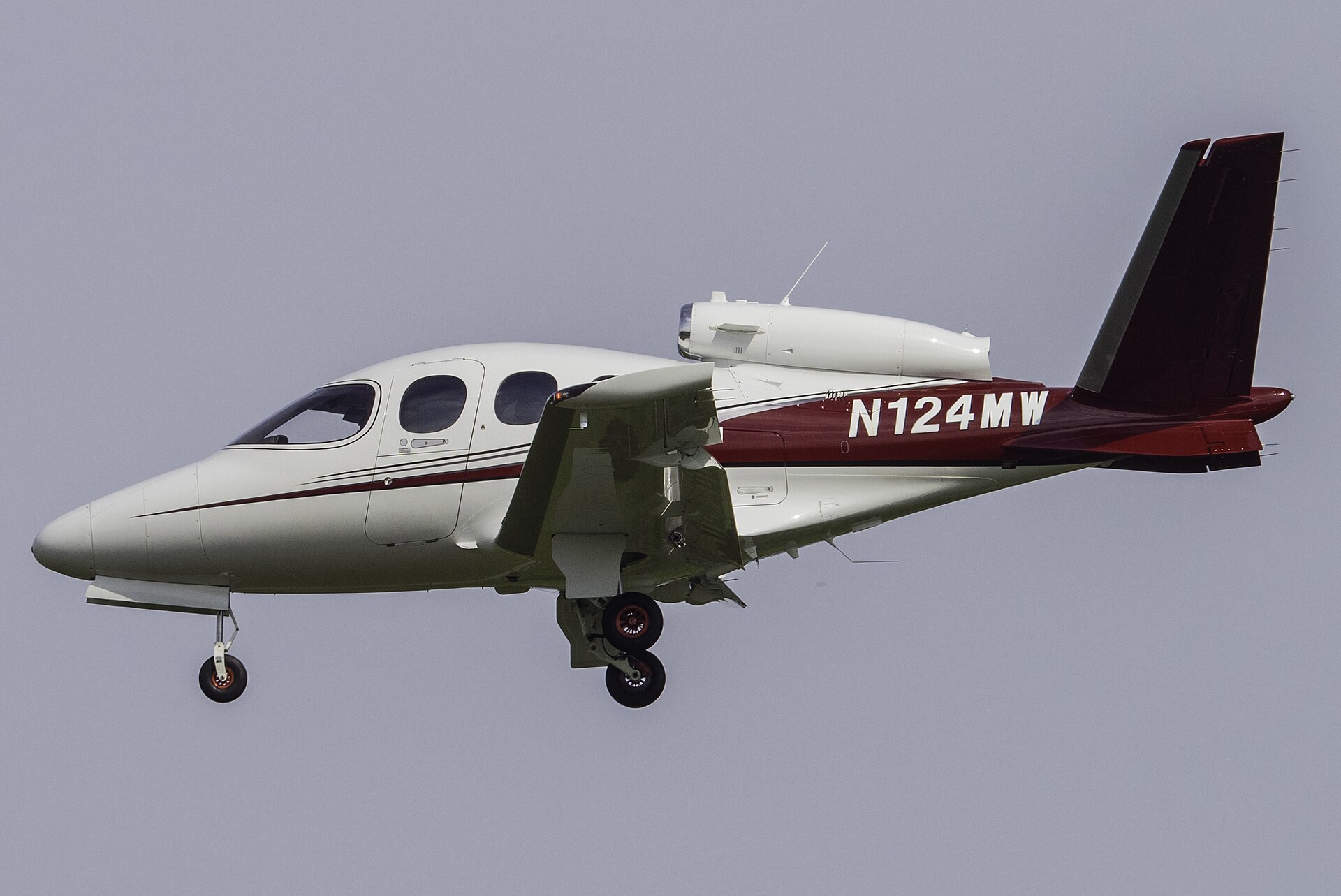
Cirrus Vision SF50 N124MW on ramp in Geneva
Cirrus Vision SF50 N124MW · Markus Eigenheer from Genève · CC BY-SA 2.0 via Wikimedia Commons

INTERIOR

Cirrus Vision SF50 cabin interior looking aft
Cirrus Vision SF50 cabin interior · Jet Request · CC BY-SA 3.0 via Wikimedia Commons
Cirrus Vision SF50 cabin interior detail
Cirrus Vision SF50 cabin interior · Jet Request · CC BY-SA 3.0 via Wikimedia Commons

SPECIFICATIONS

Cirrus Vision Jet SF50 specifications

Passengers5
Range1,275 nm
SpeedMach 0.53
Cabin height4'1"
Cabin width5'1"
Baggage30 cu ft
Runway2,036 ft

CABIN EXPERIENCE

On board the Cirrus Vision Jet SF50

  • Five seats in a club-plus-bench layout
  • Panoramic windows
  • Pressurised cabin to FL310

BEST ROUTES

Where the SF50 flies best

London → Edinburgh

from £3,400

Miami → Key West

from $3,600

BROWSE ALL ROUTES →

CHARTER PRICING

Cirrus Vision Jet SF50 charter pricing

ROUTEESTIMATED PRICE
London → Manchesterfrom £2,800
Phoenix → Las Vegasfrom $3,500

Indicative all-inclusive one-way pricing — aircraft, crew, fuel, handling, catering and taxes. Confirmed quote in 10 minutes.

WHO SHOULD CHARTER THIS

Why choose the Cirrus Vision Jet SF50?

The right client profile for the SF50: 5 passengers, missions inside its 1,275 nm range, and routes where the light jet cabin size is the sweet spot between cost and comfort.

  • CAPS whole-airframe parachute system
  • Single-engine economy
  • Short-runway access

RANGE & LIMITATIONS

What the SF50 can — and can't — do

Non-stop range

1,275 nm with typical payload. Missions beyond this figure require a technical fuel stop — expect 30–45 minutes on the ground and a modest re-quote. On strong headwinds or full-cabin days the practical range trims by 5–10%.

Runway requirement

Balanced-field length around 2,036 ft. Rules out very short-strip airfields (Courchevel, Lugano, London City steep-approach) unless the airframe is specifically certified — our ops team validates every airport pairing before we confirm the quote.

Payload & baggage

30 cu ft of hold space with 5 passengers. Ski, golf and dive equipment fit for most parties; larger groups with full luggage should size up one category to preserve the range figure above.

FAQ

Frequently asked

Is Wi-Fi available onboard?

Yes — most aircraft in this class offer high-speed Ka-band or Starlink connectivity suitable for video calls and streaming throughout cruise.

Can pets fly on board?

Pets travel in the cabin alongside their owners on every Limitless Sky charter at no extra charge. Tell us the species and weight when you request a quote.

How quickly can the aircraft be ready?

Once a quote is confirmed, this aircraft can typically be positioned within 2–4 hours anywhere in its home region, and within 24 hours globally.

FURTHER READING

Planning the SF50 for business or leisure

SIMILAR AIRCRAFT

Also in Light Jet

HEAD-TO-HEAD

Compare the SF50

ALL COMPARISONS →

CIRRUS VISION JET SF50 CLUSTER

Everything connected to the Cirrus Vision Jet SF50

Ready to charter the Cirrus Vision Jet SF50?

Quotes in 10 minutes. Aircraft positioned within hours. 24/7, worldwide.

REQUEST A QUOTE
Enquire now