Dassault Falcon 7X private jet charter

Dassault Falcon 7X Charter

Three engines, fly-by-wire, exceptional short-runway capability.

PAX14RANGE5,950 nmSPEEDMach 0.90

OVERVIEW

Dassault Falcon 7X

The Dassault Falcon 7X is the only three-engine ultra-long-range jet in production — its trijet configuration offers superior safety, smoothness and short-runway access. Certified for London City Airport, it connects city centres to global destinations in a way no rival can.

Dassault Falcon 7X cabin and exterior

IN DEPTH

The complete guide to chartering the Dassault Falcon 7X

The story behind the Dassault Falcon 7X

The Dassault Falcon 7X occupies a unique position in aviation history: it was the first business jet to enter service with a digital fly-by-wire flight control system, a technology previously confined to combat aircraft such as the Rafale, which Dassault had been developing in parallel throughout the 1990s. When the programme was unveiled at the Paris Air Show in June 2001, the industry received it with a mixture of admiration and scepticism — fly-by-wire in a business jet was an engineering ambition of a different order from the incremental refinements that characterised most new-model launches. First flight followed on 5 May 2005, and European certification was awarded in April 2007, with customer deliveries beginning in June of that year.

The design was also the first commercial aircraft to be developed entirely using CATIA V5 digital design software, enabling Dassault's engineers to simulate and refine aerodynamic behaviour, structural load paths, and systems integration with a precision that was simply unavailable to earlier programmes. The result was a wing of exceptional efficiency — incorporating winglets and optimised aerofoil geometry — that, combined with the three PW307A turbofans, produced a range figure of 5,950 nautical miles while maintaining the widebody cabin dimensions for which the Falcon family is known.

TIME magazine named the Falcon 7X one of the best inventions of 2006 before the aircraft had entered commercial service — a recognition of the programme's engineering ambition rather than its operational record. That record, accumulated over more than 270 delivered aircraft since 2007, has validated the award. The 7X was succeeded in the Dassault catalogue by the Falcon 8X, which first flew in 2015 and which extends the same trijet formula to a range of 6,450 nm with a longer fuselage. The 7X continues in production alongside the 8X and remains the more widely available of the two in the charter market.
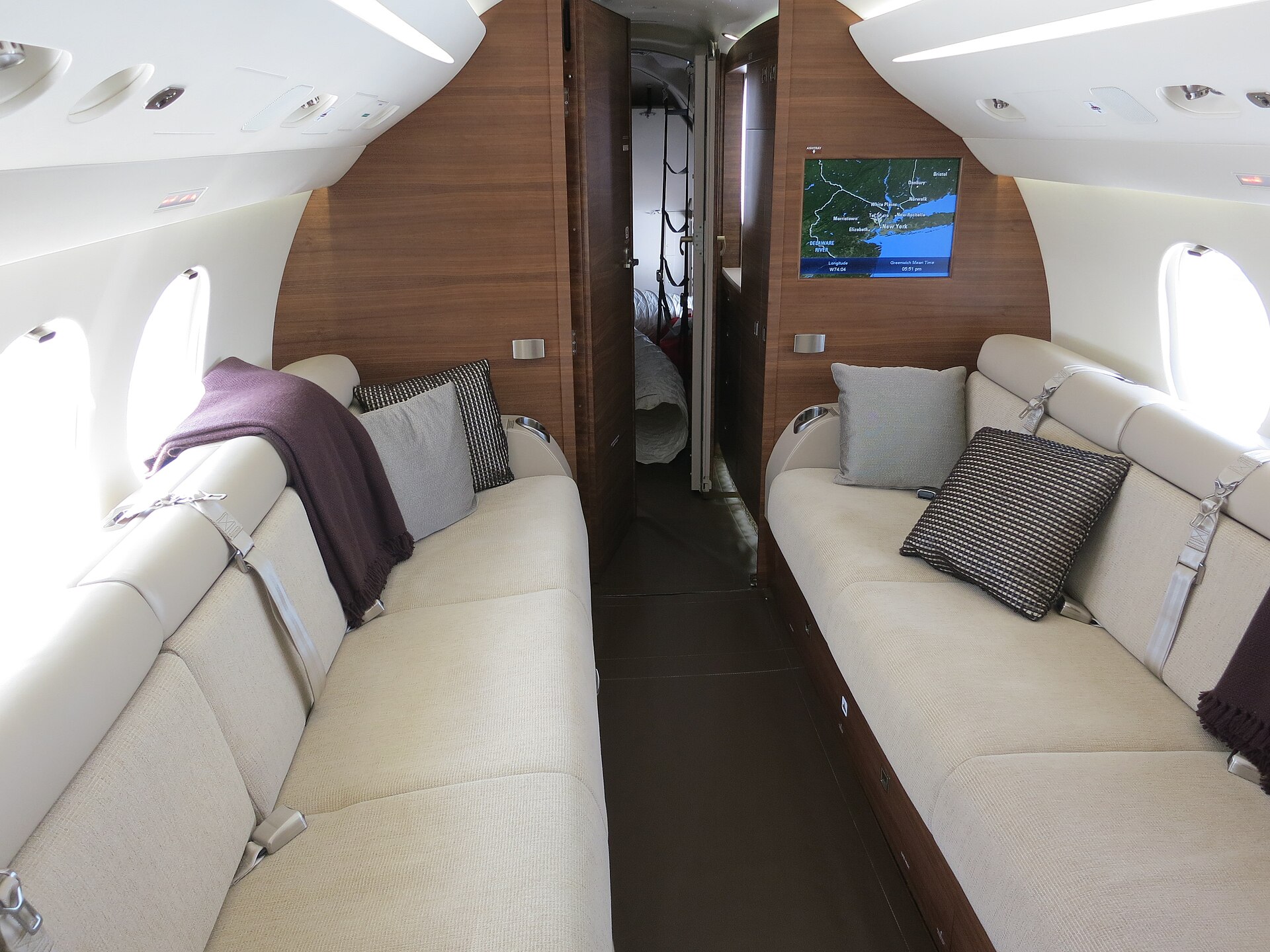
On board: the cabin

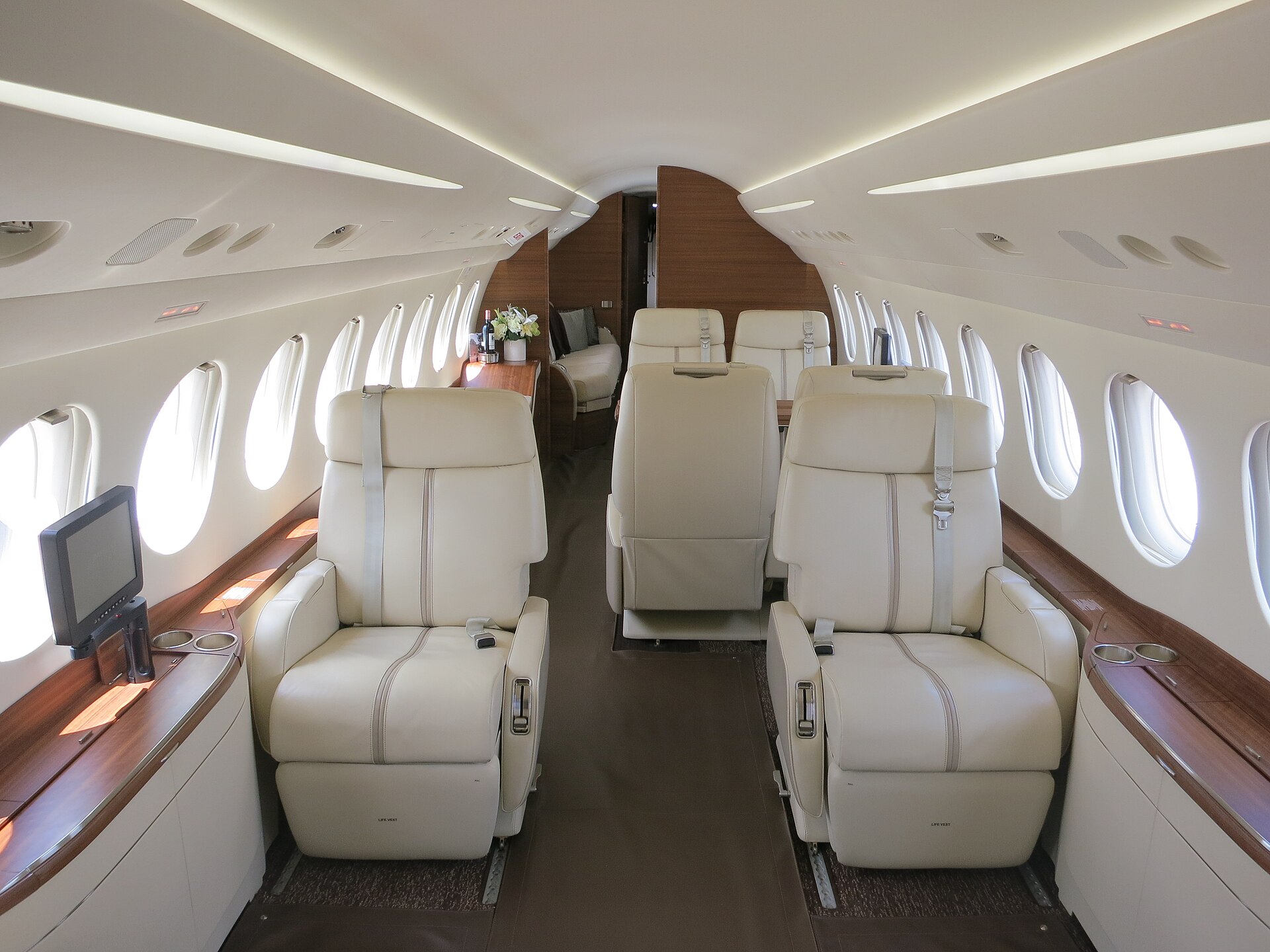
The Falcon 7X cabin measures 39.1 feet in length, 7.7 feet in width, and 6.2 feet in height. That 7.7-foot width is the widebody standard that Dassault has maintained across its Falcon family since the original 900, and it produces a qualitative difference in the passenger experience that is immediately apparent on boarding — a genuine four-abreast seating geometry with a centre aisle wide enough to pass without turning sideways, rather than the narrower cross-sections accepted as normal in competing heavy jets. The standard three-zone configuration accommodates up to twelve passengers in a forward lounge, a central dining and working area, and an aft lounge or divan.

The cabin's 28 windows — more than any competitor of comparable size — admit exceptional natural light and allow passengers a constant visual connection to the outside, which has measurable physiological benefits on long sectors. Dassault's advanced acoustic engineering, applied to the structure, engine nacelles, and cabin interior simultaneously, produces sound levels in cruise that are among the lowest in the heavy-jet category. The combination of natural light, low noise, low cabin altitude, and wide cabin cross-section translates, in practical terms, to significantly less fatigue on arrival from a nine-to-ten-hour sector compared with competing aircraft.

The EASy II flight deck extends into the passenger domain through Dassault's FalconCabin HD+ management system, which provides integrated control of lighting, temperature, window shades, entertainment, and Ka-band broadband connectivity from a central touchscreen interface or from individual passenger panels. The galley, forward adjacent to the crew door, is equipped for full hot meal preparation. Baggage volume is 140 cubic feet — adequate for twelve passengers on trips of up to a week without checked luggage constraints — and the hold is pressurised and accessible from the external baggage door.

Performance, range and runway access

At 5,950 nautical miles with eight passengers at Mach 0.80 under NBAA IFR conditions, the Falcon 7X's range positions it as a genuine ultra-long-range aircraft rather than a long-range one. Paris to Washington DC at approximately 3,650 nm is nonstop with a comfortable margin; London to Los Angeles at approximately 5,200 nm is achievable with a reduced payload in favourable conditions. London to Dubai is a routine four-and-a-half-hour sector. The maximum certified altitude of 51,000 feet — matched only by the G550 and the G650 in the charter market — allows the aircraft to fly above the majority of North Atlantic weather systems and air traffic.

The trijet configuration of three Pratt & Whitney Canada PW307A engines, each producing 6,400 lb of thrust, is a defining operational characteristic. Unlike twin-engine aircraft that must maintain an extended diversion envelope under ETOPS certification over oceanic routes, the 7X's third engine provides an additional safety margin that has made it the preferred choice for operators whose routes cross remote ocean areas or whose safety management systems regard twin-engine extended operations with caution. The asymmetric rear-engine arrangement — one engine on each side of the aft fuselage, one centreline through the tail — also provides improved directional control following a single-engine failure compared with a twin.

Short-field performance is the 7X's other distinguishing operational advantage. Balanced field length at sea level standard conditions is approximately 5,710 feet, and the aircraft can operate from runways as short as 4,500 feet at reduced weights. This allows access to London City, Biarritz, Innsbruck, Courchevel, and a range of Mediterranean and Middle Eastern secondary airports from which both the G550 and the Global 6000 are excluded. Combined with 5,950 nm range, this produces a route map of unusual breadth: the 7X can fly London City to Dubai direct, or land at a mountain airstrip in the Alps before departing for New York the following morning.

Signature missions and best routes

The Falcon 7X's signature mission is any itinerary that combines ultra-long range with access to restricted airports — the combination that no competing single type can replicate. A programme beginning with a departure from London City (LCY), stopping for two nights at Innsbruck (INN), then flying direct to Dubai (DXB), then returning to Nice Côte d'Azur (NCE) encompasses four airports of which only Nice is routinely accessible to the G550 or Global 6000, yet the entire programme requires only the 7X to be scheduled for the full week.

Transatlantic operations are entirely within the aircraft's comfort zone. London to New York at approximately 3,470 nm uses roughly 58 percent of the aircraft's certificated range, leaving substantial reserves for weather diversion or speed increase. Paris to Washington Dulles, a route frequently demanded by European corporate users with US government or consultancy engagements, is 3,650 nm and similarly comfortable. London to Toronto at approximately 3,550 nm, and London to Montreal at 3,260 nm, are both nonstop.

Eastward, the 7X reaches Dubai in under five hours from London, Riyadh in under four and a half, and Mumbai in approximately seven and a half hours. Singapore at approximately 6,700 nm from London is beyond the aircraft's nonstop range and requires a single technical stop, typically Dubai or Colombo — an acceptable compromise compared with the two-stop itineraries that shorter-range aircraft require. London to Hong Kong at approximately 5,800 nm is achievable nonstop with a reduced passenger load and favourable routing.

Operating economics and charter pricing

Charter rates for the Falcon 7X sit in the range of approximately £8,000–£9,500 per flight hour in the current European market, equivalent to roughly $10,000–$12,000 USD or €9,200–€11,000. The trijet configuration adds a modest fuel consumption premium versus comparable twin-engine aircraft over the same sector — a PW307A aircraft burns slightly more fuel per nautical mile than an equivalent twin — but the safety margins, runway flexibility, and cabin quality that come with the Falcon 7X justify that differential for the majority of clients who choose it.

On representative sectors, London Farnborough to New York for ten passengers would typically be quoted between £92,000 and £115,000 one-way. London to Dubai runs approximately £65,000–£80,000. Paris to Beijing with a single technical stop in Dubai would be quoted in the region of £130,000–£155,000. London to Cape Town with a stop in West Africa, typically Dakar or Accra, would be approximately £110,000–£130,000. European sectors — London to Moscow, Geneva to Tel Aviv, Paris to Riyadh — run from £30,000 to £55,000 depending on distance and routings.

Three-engine maintenance naturally involves a higher parts count than a twin, but Pratt & Whitney Canada's Purepower EAGLE service programme provides cost-per-flight-hour coverage that removes unbudgeted overhaul risk. Dassault's service network, with authorised maintenance facilities at Farnborough, Paris Le Bourget, and Bordeaux Mérignac in Europe and Le Bourget-calibre standards at support stations in Dubai and Beirut, ensures that the 7X fleet achieves high dispatch reliability despite the additional mechanical complexity of the trijet arrangement.

How the Falcon 7X compares

The Falcon 7X's most direct competitors are the Gulfstream G550, the Bombardier Global 6000, and Dassault's own Falcon 8X. Against the G550, the 7X concedes approximately 800 nautical miles of range (5,950 nm versus 6,750 nm) and a longer cabin (50.1 feet versus 39.1 feet), but counters with a wider cabin cross-section (7.7 feet versus 7.3 feet), materially better short-field performance, trijet safety margins, and a cabin environment that most objective assessments rate as the more comfortable per seat for groups of ten to twelve. For missions within 5,500 nm, the two aircraft are competitive; beyond that, the G550's range advantage becomes dispositive.

Against the Bombardier Global 6000, the contest is similarly nuanced. The Global 6000 offers a wider cabin floor at 7.8 feet and a range of approximately 6,000 nm — slightly better than the 7X — but the Falcon counters with short-field performance, trijet reliability, the EASy II cockpit, and Dassault's reputation for handling precision and build quality. Charter rates are broadly similar, and the choice between the two frequently resolves itself into operator preference and crew training infrastructure rather than objective performance metrics.

The Falcon 8X, Dassault's current ultra-long-range flagship, is the 7X's most direct successor: same cabin width, trijet configuration, and fly-by-wire architecture, but 6,450 nm range and a 40-inch fuselage extension providing additional cabin length. The 8X commands a charter rate premium of approximately 15–20 percent, which is justified for missions that need the extra 500 nm of range. For the large proportion of ultra-long-range missions that fall within the 7X's 5,950 nm capability, the older aircraft represents exceptional value.

Verdict: who should charter the Falcon 7X?

The Falcon 7X is the aircraft for clients who require genuinely ultra-long-range capability — transatlantic, Middle East, and North African reach from a single base — combined with the ability to land at airports that most competing heavy jets cannot access. No other aircraft in the charter market combines a certified range above 5,000 nm with the short-field performance to operate from London City, Innsbruck, or Courchevel. That combination is disproportionately valuable for clients whose itineraries mix major hub operations with secondary airport visits, as a significant fraction of real-world European corporate and leisure travel does.

The widebody cabin, the exceptional natural light from 28 oversized windows, and the acoustic engineering that makes long-sector travel genuinely restful give the 7X a passenger experience that consistently benchmarks at or above its price point. Groups of ten to twelve will find the three-zone layout flexible enough to accommodate separate working, dining, and resting activities simultaneously, without the queuing conflicts that arise on shorter-cabin aircraft.

Clients for whom the 7X may not be the optimal choice include those whose missions consistently require more than 5,950 nm nonstop — particularly anyone regularly flying London to Singapore direct or New York to Tokyo without a stop, where the G550 or G650 holds a decisive range advantage. Charter clients on a tight budget who are flying within Europe will also find the LXS or Challenger 350 more economical for sub-3,000 nm missions. For everyone in the middle — European bases, global programmes, a mixed itinerary of hub airports and secondary strips, and a group of eight to twelve — the Falcon 7X is arguably the most comprehensively capable charter aircraft available.

PHOTO GALLERY

Dassault Falcon 7X — exterior & cabin

Reference photography of the Dassault Falcon 7X (and sister types within the same cabin family where noted). Images sourced from Wikimedia Commons under Creative Commons licences.

EXTERIOR

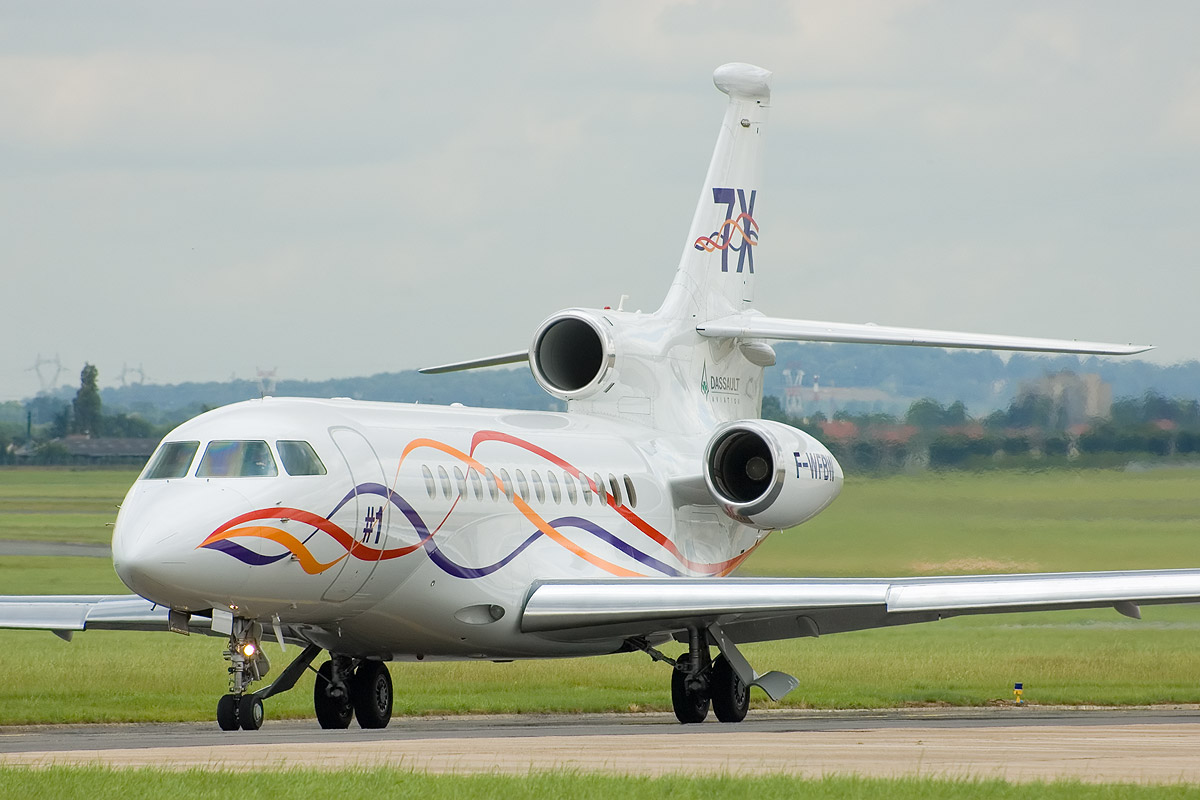
Dassault Falcon 7X
Dassault Falcon 7X · Dmitry A. Mottl · Public domain via Wikimedia Commons
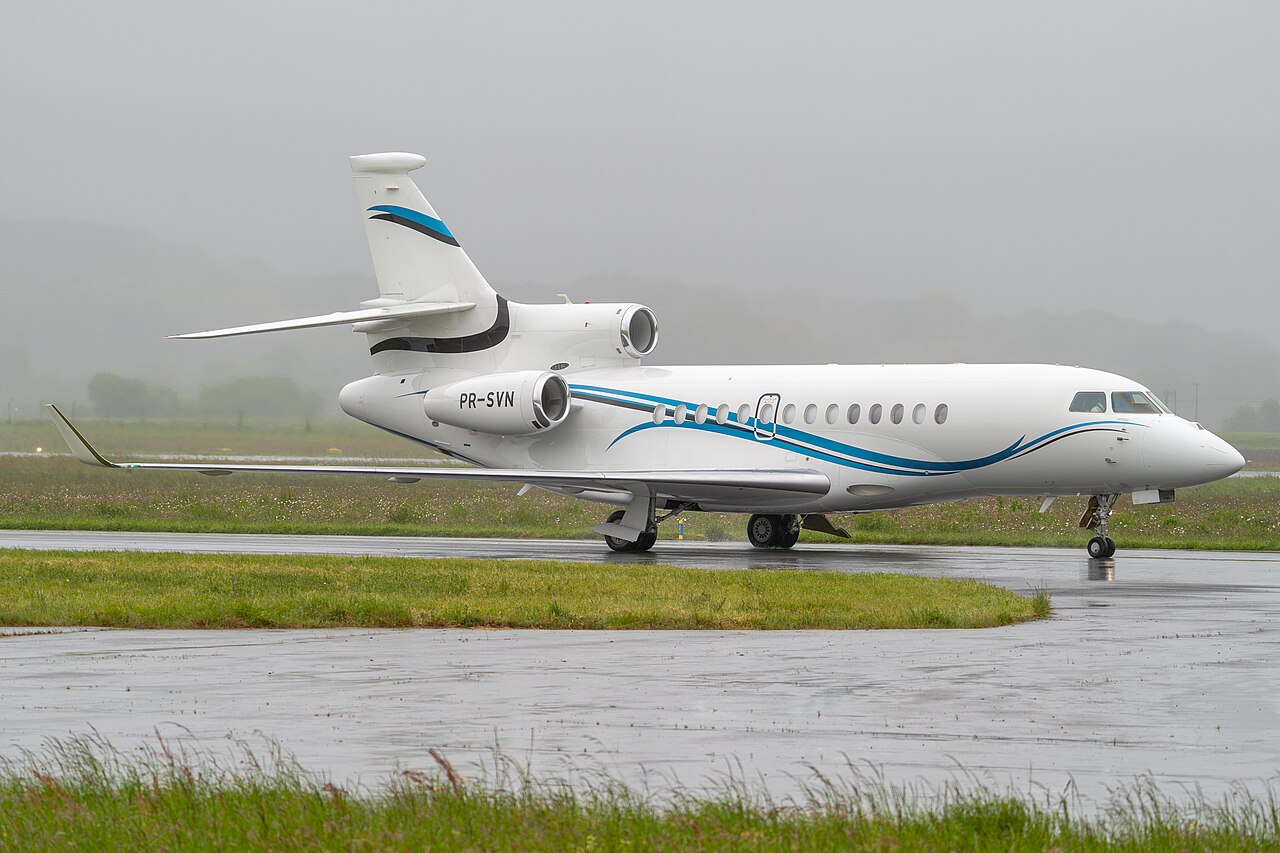
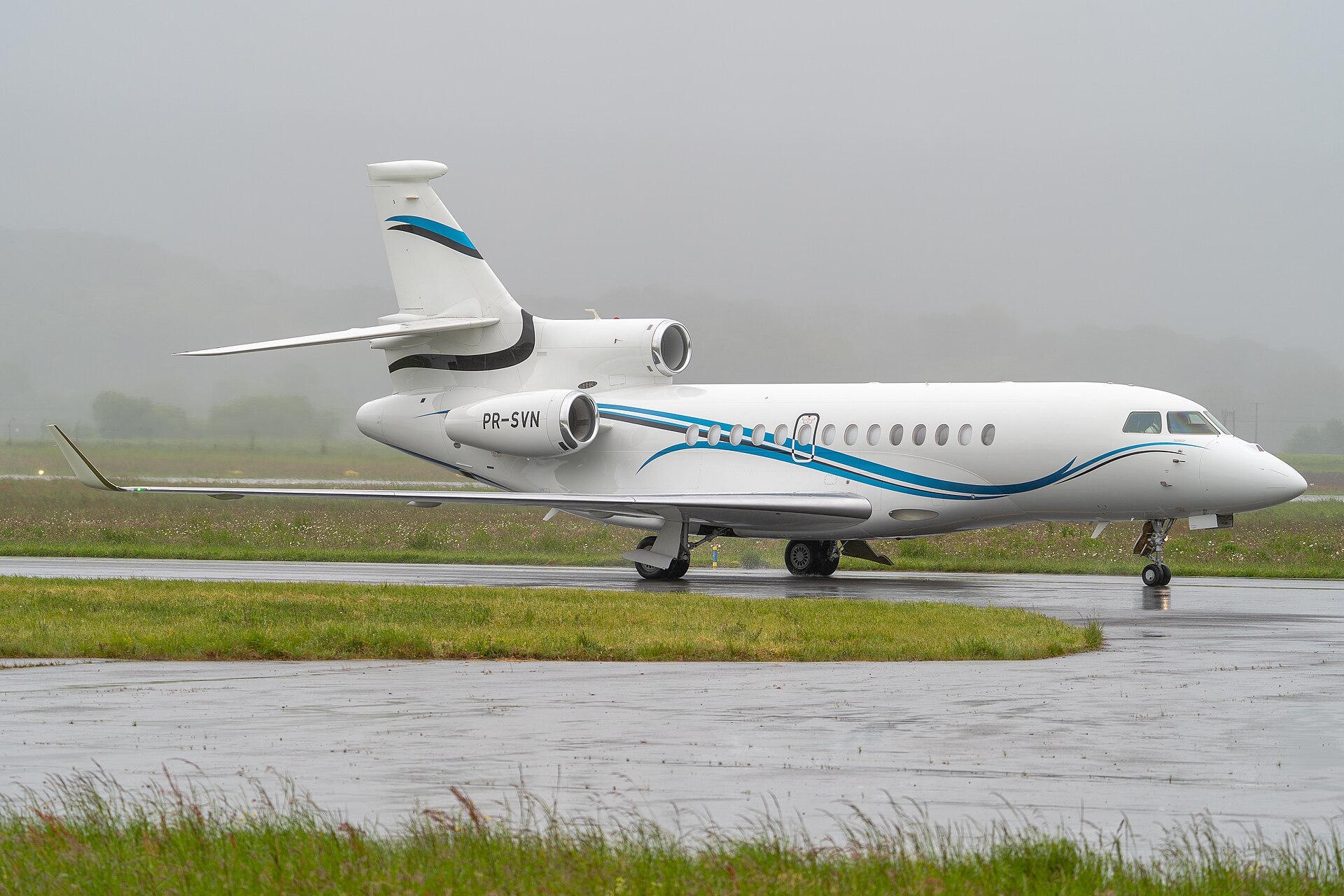
Dassault Falcon 7X - PR-SVN on taxiway at LFBT airport
Dassault Falcon 7X - PR-SVN on taxiway at LFBT airport · Hugo LUC · CC BY-SA 4.0 via Wikimedia Commons

INTERIOR

Dassault Falcon 7X aft cabin and bedroom
Dassault Falcon 7X aft cabin and bedroom · JetRequest.com · CC BY-SA 3.0 via Wikimedia Commons
Dassault Falcon 7X forward cabin interior
Dassault Falcon 7X forward cabin interior · JetRequest.com · CC BY-SA 3.0 via Wikimedia Commons

SPECIFICATIONS

Dassault Falcon 7X specifications

Passengers14
Range5,950 nm
SpeedMach 0.90
Cabin height6'2"
Cabin width7'8"
Baggage140 cu ft
Runway5,710 ft

CABIN EXPERIENCE

On board the Dassault Falcon 7X

  • Three living zones
  • Fly-by-wire flight controls
  • London City certified — only ultra-long jet so approved

BEST ROUTES

Where the 7X flies best

London City → New York

from £108,000

Paris → Dubai

from €88,000

BROWSE ALL ROUTES →

CHARTER PRICING

Dassault Falcon 7X charter pricing

ROUTEESTIMATED PRICE
Geneva → Tokyofrom CHF 175,000
Riyadh → New Yorkfrom $145,000

Indicative all-inclusive one-way pricing — aircraft, crew, fuel, handling, catering and taxes. Confirmed quote in 10 minutes.

Why choose the Dassault Falcon 7X?

  • Only three-engine business jet in production
  • Certified for London City Airport
  • Dassault build quality

FAQ

Frequently asked

Is Wi-Fi available onboard?

Yes — most aircraft in this class offer high-speed Ka-band or Starlink connectivity suitable for video calls and streaming throughout cruise.

Can pets fly on board?

Pets travel in the cabin alongside their owners on every Limitless Sky charter at no extra charge. Tell us the species and weight when you request a quote.

How quickly can the aircraft be ready?

Once a quote is confirmed, this aircraft can typically be positioned within 2–4 hours anywhere in its home region, and within 24 hours globally.

SIMILAR AIRCRAFT

Also in Ultra Long Range

HEAD-TO-HEAD

Compare the 7X

ALL COMPARISONS →

DASSAULT FALCON 7X CLUSTER

Everything connected to the Dassault Falcon 7X

Ready to charter the Dassault Falcon 7X?

Quotes in 10 minutes. Aircraft positioned within hours. 24/7, worldwide.

REQUEST A QUOTE