Embraer Phenom 100EV private jet charter

Embraer Phenom 100EV Charter

Entry-level Embraer jet with BMW Designworks cabin.

PAX4RANGE1,178 nmSPEEDMach 0.70BAGGAGE53 cu ftCABIN4'11" × 5'1"TYPICALLondon → Amsterdam · from £3,000

OVERVIEW

Embraer Phenom 100EV

The Embraer Phenom 100EV brings BMW Designworks cabin design and Garmin G3000 avionics to the very-light-jet segment. Four passengers, single-pilot economy and class-leading short-runway access.

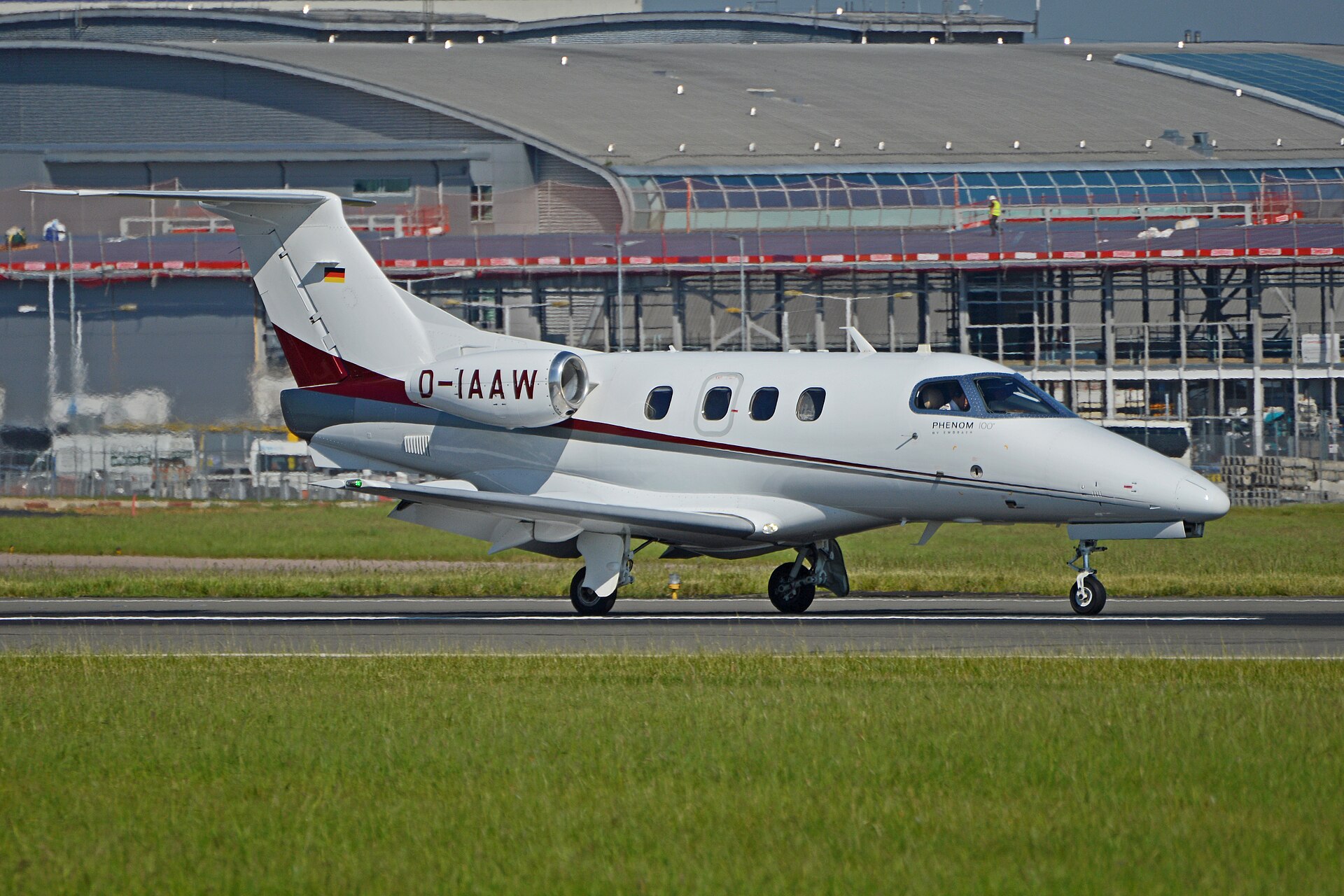
Embraer Phenom 100EV at EBACE 2019, Geneva

IN DEPTH

The complete guide to chartering the Embraer Phenom 100EV

The story behind the Phenom 100EV

The Embraer Phenom 100 was the aircraft that legitimised Embraer's executive-jet ambitions. Announced in 2005 and first delivered in 2008, it beat the entrenched Cessna Mustang in every dimension that mattered to the very-light-jet market — bigger cabin, better avionics, more contemporary design — and quickly became the best-selling aircraft in its category. The current Phenom 100EV, introduced in 2017, added more powerful Pratt & Whitney PW617F1-E engines with FADEC, a Garmin G3000 flight deck (replacing the original Prodigy) and an updated interior that carries clear DNA from the larger Phenom 300E and Praetor programmes.

More than 400 Phenom 100 airframes have now been delivered, of which roughly 90 are the EV variant flying with charter operators, fractional programmes (particularly NetJets Europe until its recent fleet renewal) and small corporate flight departments. The aircraft is more common in Europe and Latin America than in the US, where the CJ family and Mustang built entrenched positions before the Phenom arrived.

For charter clients, the 100EV is the aircraft you book when you want the polish and cabin sensibilities of the larger Phenom 300 in a smaller, cheaper, single-pilot airframe. It carries the same Bossa Nova interior language, the same premium touchpoints and the same short-runway credentials as its bigger sibling.

On board: the Oval Lite cabin

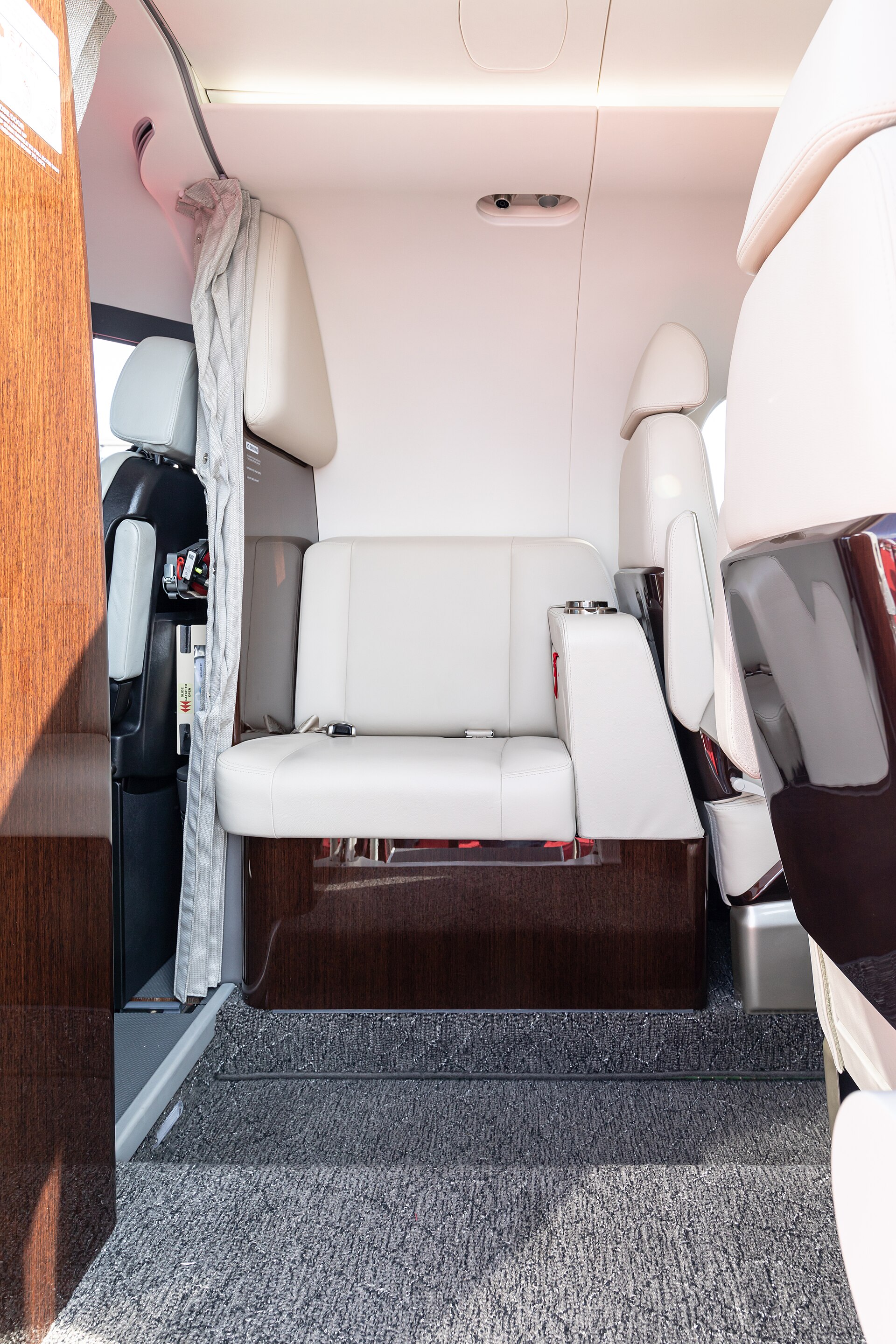
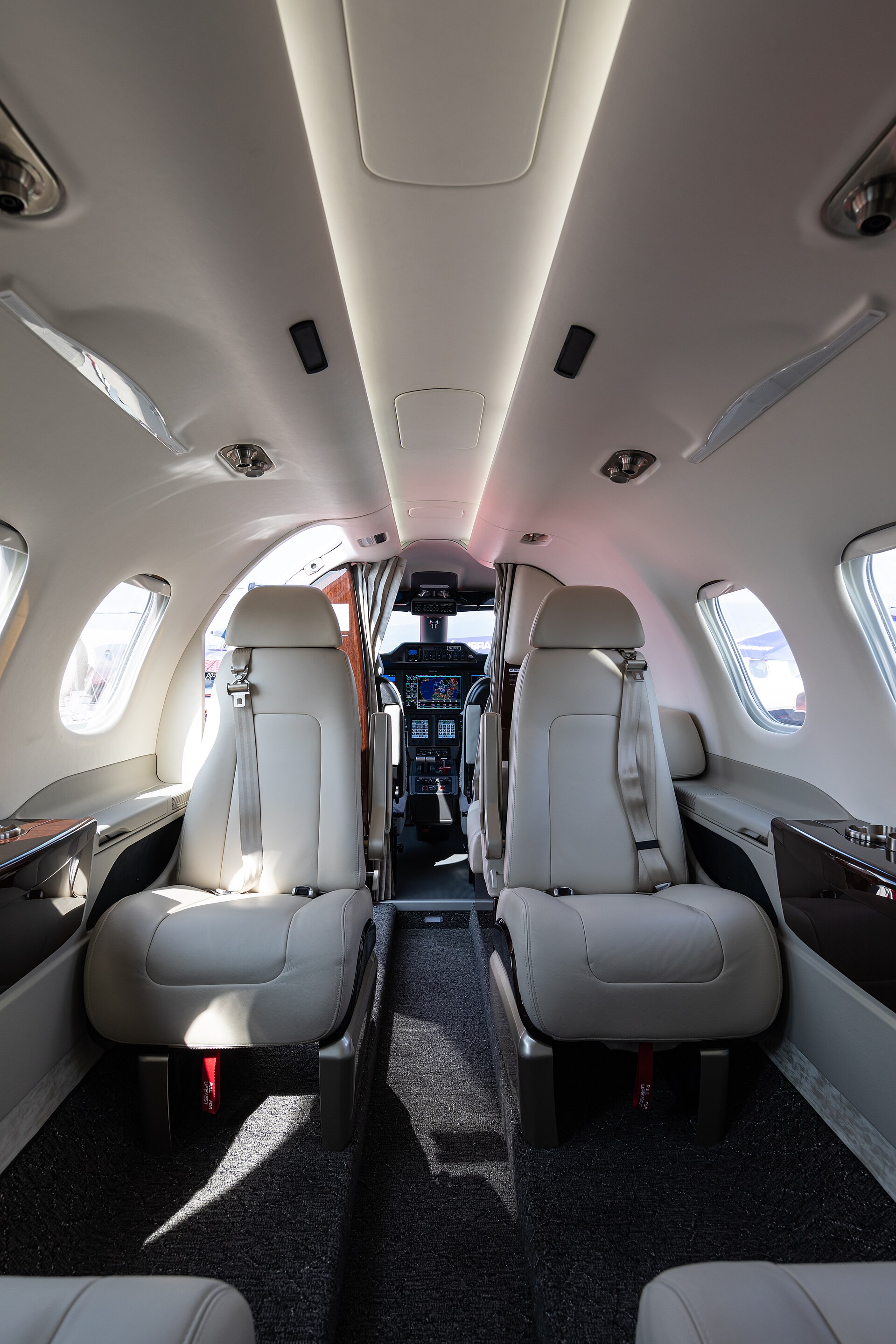
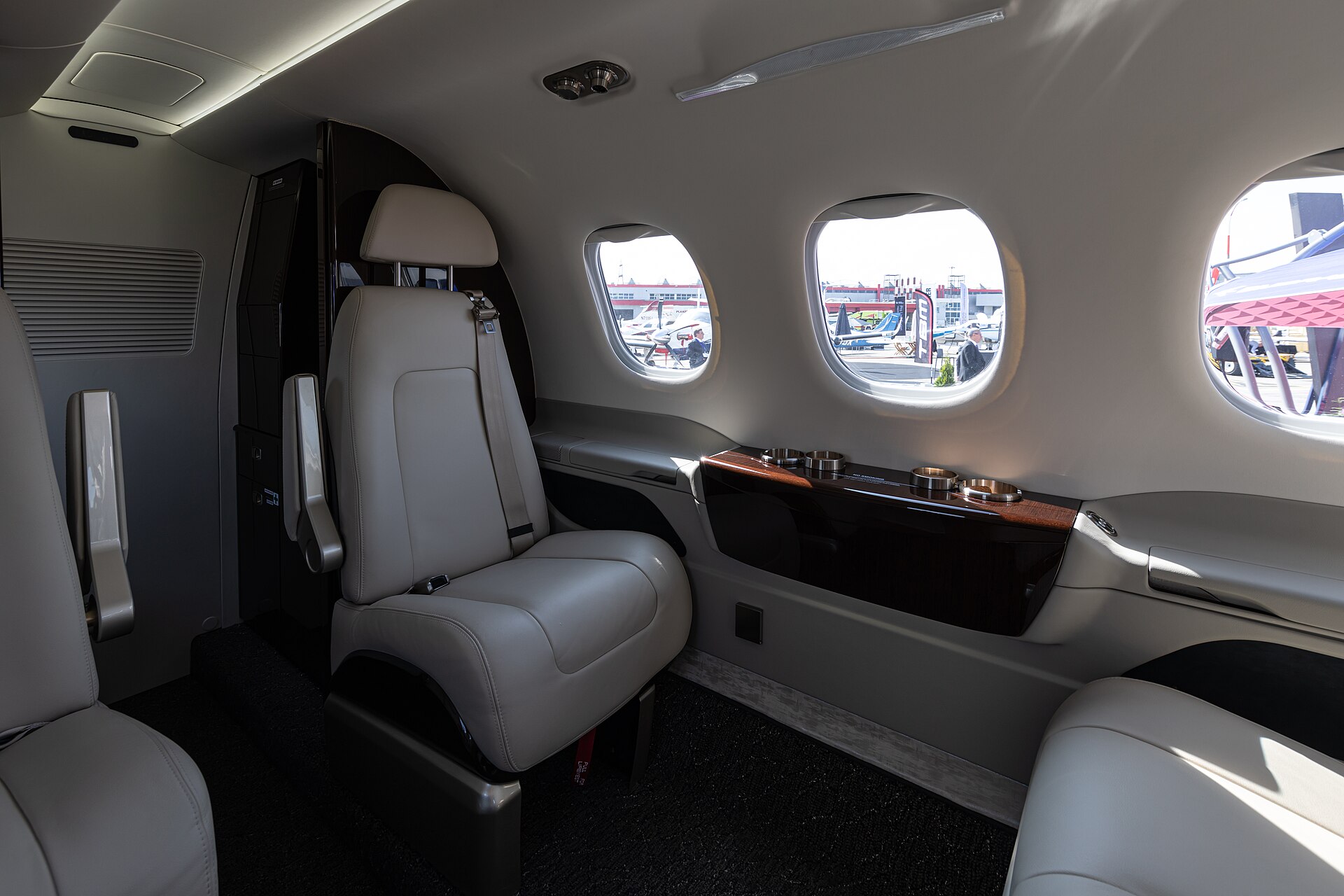
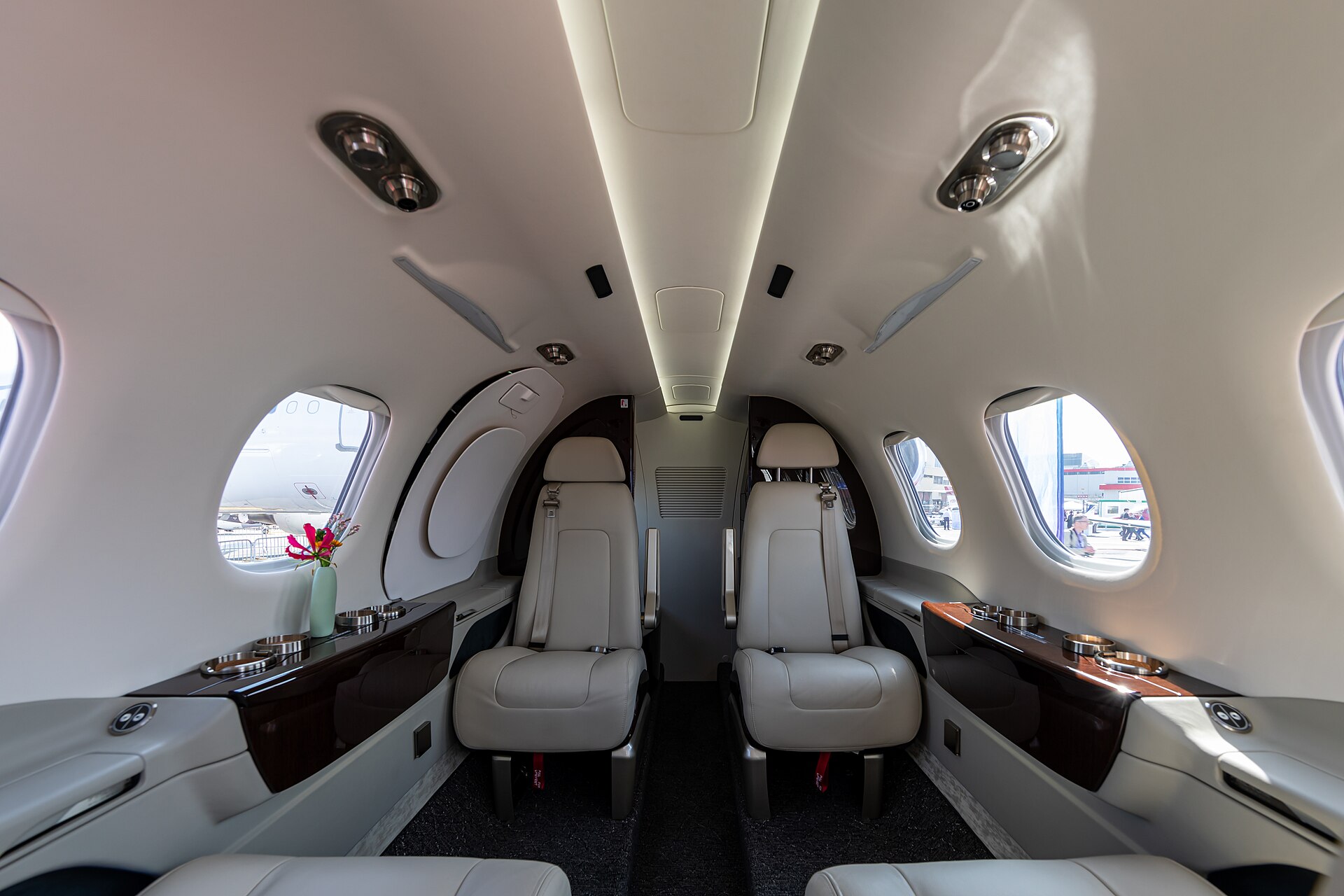
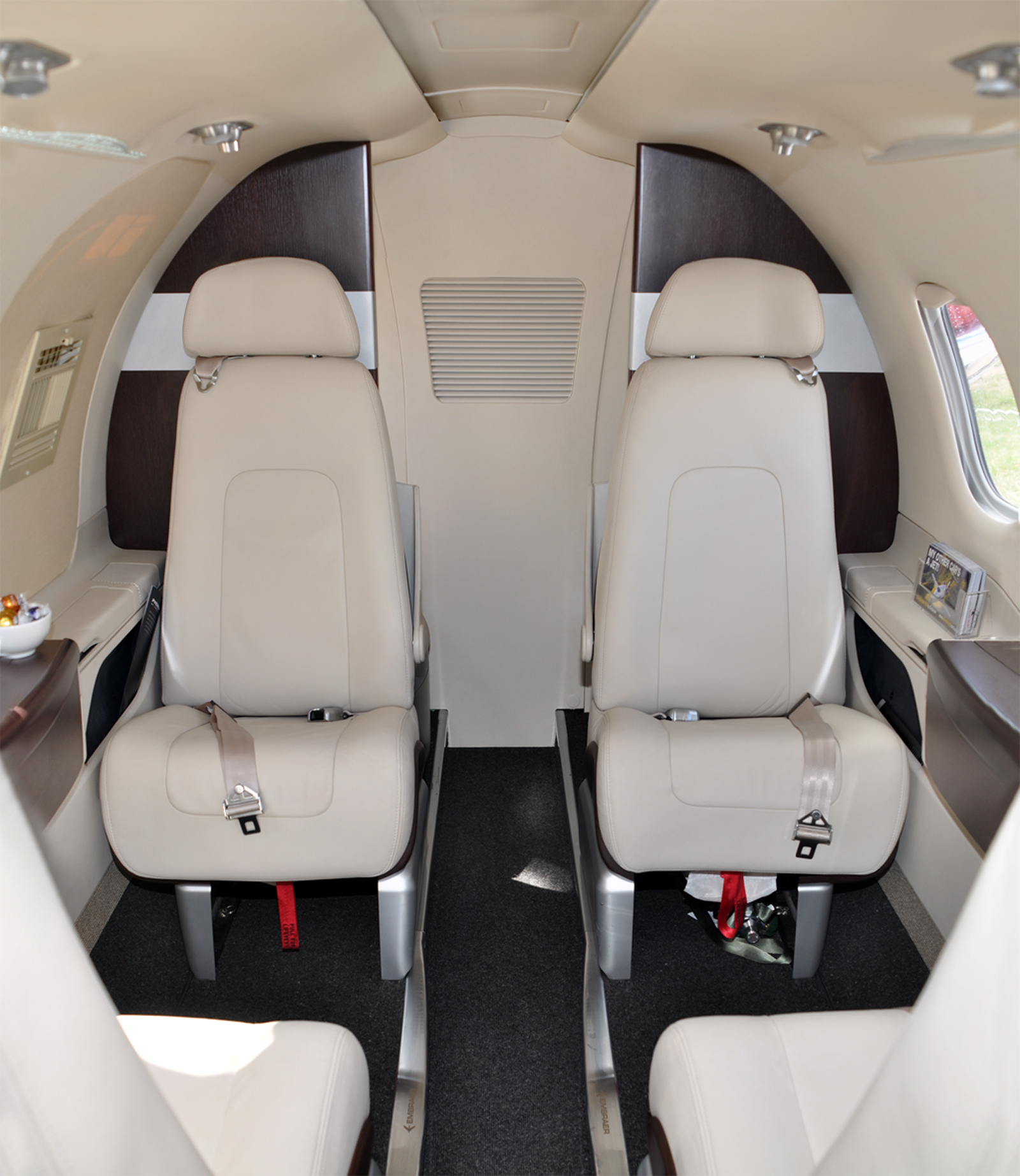
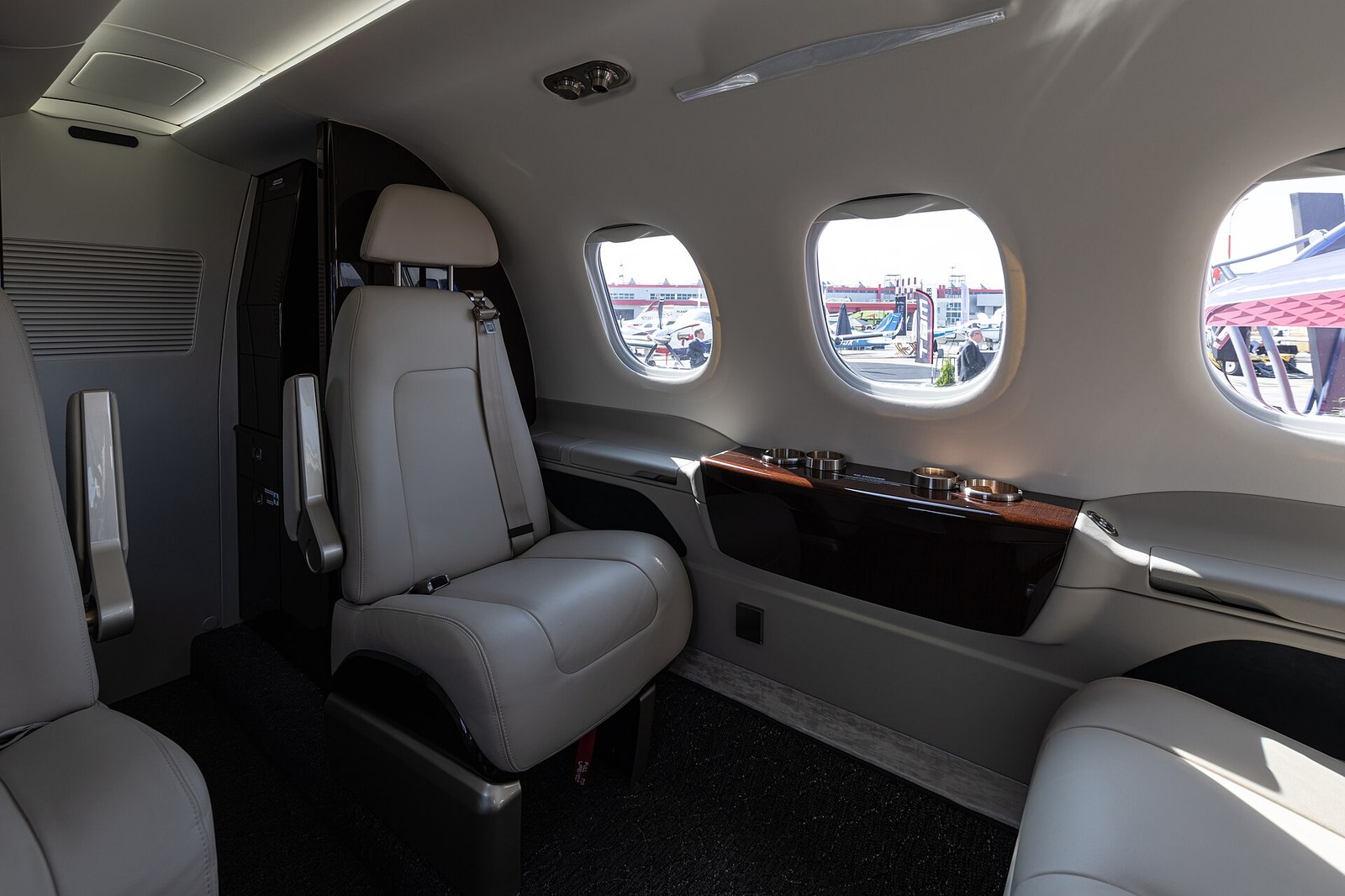
The Phenom 100EV's most distinctive feature is its cabin cross-section. Embraer's designers gave the 100EV the same "Oval Lite" fuselage geometry as the Phenom 300, meaning 5 feet 1 inch of cabin height and 5 feet 1 inch of width — wider and taller than the M2, Mustang, or HondaJet, and the only VLJ with genuine "walking" clearance for the average adult. Cabin length is 11 feet, configured as four club seats plus one belted lavatory seat aft.

Materials are notably premium for the class: full leather, contemporary Brazilian design under the BMW Designworks partnership, diamond-stitched sidewalls on the current EV trim, and warm walnut or brushed-metal accents at each seat. The seats themselves fully recline and track, with tables that fold cleanly from the sidewall. USB and 110V outlets are present at every position.

The 100EV is the only VLJ with a genuinely enclosed aft lavatory — belted, ventilated, with a real vanity and a proper door. That is a meaningful comfort upgrade on any flight over an hour and one of the reasons the aircraft is quietly preferred by charter clients over the M2 and Mustang despite similar pricing. Baggage capacity totals 53 cubic feet across an internal nose locker and heated aft hold.

The Garmin G3000 Prodigy Touch flight deck is single-pilot certified, synthetic-vision equipped, LPV-approach capable and configured on most airframes with Gogo AVANCE L3 connectivity. Cabin management runs through the passenger's own phone via the Embraer app for lighting, temperature and window-shade control.

Performance, range and runway access

Twin Pratt & Whitney Canada PW617F1-E turbofans deliver 1,730 lbf of thrust each — 20 percent more than the original Phenom 100 — and give the EV a maximum cruise of 406 knots true (Mach 0.70) and a normal high-speed cruise of Mach 0.68. Certified ceiling is FL410, above most weather and traffic. NBAA IFR range with four passengers is 1,178 nautical miles.

Practical mission examples: London to Milan, Paris to Barcelona, Geneva to Rome, Frankfurt to Nice, Vienna to Athens (four pax, tight reserves), Teterboro to Chicago, Miami to Nassau. Longer transcontinental sectors fall outside the aircraft's operational envelope and require a fuel stop.

Runway performance is genuinely excellent for the class: take-off field length is 3,190 ft at maximum weight, landing distance is 2,430 ft. That opens Lugano, Sion, London City (with steep-approach mod), Innsbruck, Aspen, Sun Valley, Nantucket and the majority of European regional fields. The aircraft's hot-and-high climb performance is a notable strength.

Fuel burn sits at approximately 100 US gallons per hour in cruise — the lowest of any twinjet, roughly tied with the Eclipse 550 and 20 percent lower than the Citation M2. Combined with single-pilot operation, this delivers a direct operating cost of $1,050–$1,400 per flight hour.

Signature missions and best routes

The Phenom 100EV is at its best on European city-to-city executive travel where the airline alternative is genuinely slow or inconvenient: London to Amsterdam, Zurich to Milan, Paris to Munich, Frankfurt to Geneva, Vienna to Prague. On these one-to-two-hour hops the 100EV's Oval Lite cabin punches meaningfully above its category and the total door-to-door time advantage over an airline first-class product is 90 minutes to two hours.

A second cluster of missions plays to the aircraft's short-runway performance for weekend leisure travel: London to Le Touquet, Munich to Innsbruck, Zurich to Sion, Frankfurt to Sylt, Paris to St. Tropez / La Môle. The 100EV is one of very few jets that can land at these airfields, and the cost of doing so is close to what the same passengers would pay for a turboprop.

In the US, the 100EV competes head-to-head with the Citation M2 and HondaJet Elite II on short regional missions — Teterboro to Boston, Dallas to Austin, Miami to Naples FL, Chicago to Detroit. The Phenom's larger cabin and enclosed lavatory usually swing the choice when the operator makes the aircraft available at competitive rates.

Operating economics and charter pricing

Charter rates for the Phenom 100EV typically fall between $3,000 and $3,800 per hour in North America and €3,100–€3,900 in Europe — essentially at parity with the Citation M2 and HondaJet Elite II. Indicative all-inclusive one-way pricing: London to Milan from £6,900; Geneva to Nice from €3,400; London to Amsterdam from £3,900; Miami to Nassau from $4,100; Teterboro to Boston from $5,600.

Empty-leg availability on the 100EV is strongest in Europe, particularly out of Portuguese, Spanish, Swiss and German operators who use the aircraft heavily for short-haul relocation. Flexible clients can typically find one-way relocation legs at 45–55 percent of confirmed charter pricing.

Operating economics are best-in-class for a certified twinjet: approximately 100 gallons per hour of Jet A, single-pilot operation, and comparatively low airframe maintenance costs. Direct operating cost sits around $1,050–$1,400 per flight hour excluding capital, which is what allows operators to price the aircraft competitively against turboprops on regional missions.

How the 100EV compares

Against the Citation M2 Gen2, the 100EV wins on cabin width and height, on lavatory quality (fully enclosed vs curtained) and on cabin design polish; the M2 wins on range (1,550 nm vs 1,178 nm), on service network depth, and on availability in the US. On charter rate the two are essentially at parity — the choice usually comes down to which aircraft the operator has available at the time.

Against the HondaJet Elite II, the 100EV offers a modestly larger cabin and enclosed lavatory; the HondaJet wins on speed (Mach 0.72 vs 0.70), on cabin noise (over-the-wing engines are quieter), and on Garmin Autoland safety. Cost is similar.

Against the Citation Mustang and Eclipse 550, the 100EV is meaningfully better equipped in every dimension that matters — cabin, avionics, range, comfort — at a modest premium in hourly rate. For charter clients the 100EV is almost always the more sensible choice unless price is the single overriding constraint.

Against a step up to the Phenom 300E, the 100EV gives up 900 nm of range, four seats of capacity and 40 knots of speed in exchange for roughly 30 percent lower hourly cost. On short hops the 100EV is the right answer; on anything two hours or longer, the 300E pays back.

Verdict: who should charter the Phenom 100EV?

The Embraer Phenom 100EV is the right aircraft for three or four passengers on short European or US regional missions who value a larger, more refined cabin than any other very-light jet offers, and who want the reassurance of an enclosed lavatory on flights over an hour. Its natural clients are executives on 60–120 minute city-pair sectors, families ferrying to short-runway leisure destinations and cost-sensitive charter clients who would otherwise settle for a turboprop or a smaller VLJ.

It is not the right aircraft for six-passenger groups (an Oval Lite cabin still only sleeps four properly), for multi-hour missions (a Phenom 300 or CJ4 pays back many times over) or for clients whose itineraries include intercontinental routing. On its target missions, however, the 100EV is arguably the most complete very-light jet on the market — the aircraft that quietly beats every other VLJ on cabin, and that ties or beats them on everything else.

Limitless Sky sources the Phenom 100EV through European fractional and Part-NCC operators as well as US Part 135 fleets. Contact charter@thelimitlesssky.com with your intended sectors and we will return an all-inclusive quotes in about 10 minutes.

PHOTO GALLERY

Embraer Phenom 100EV — exterior & cabin

Reference photography of the Embraer Phenom 100EV (and sister types within the same cabin family where noted). Images sourced from Wikimedia Commons under Creative Commons licences.

EXTERIOR

Embraer Phenom 100EV at EBACE 2019, Geneva
Embraer Phenom 100EV at EBACE 2019 · Matti Blume · CC BY-SA 4.0 via Wikimedia Commons
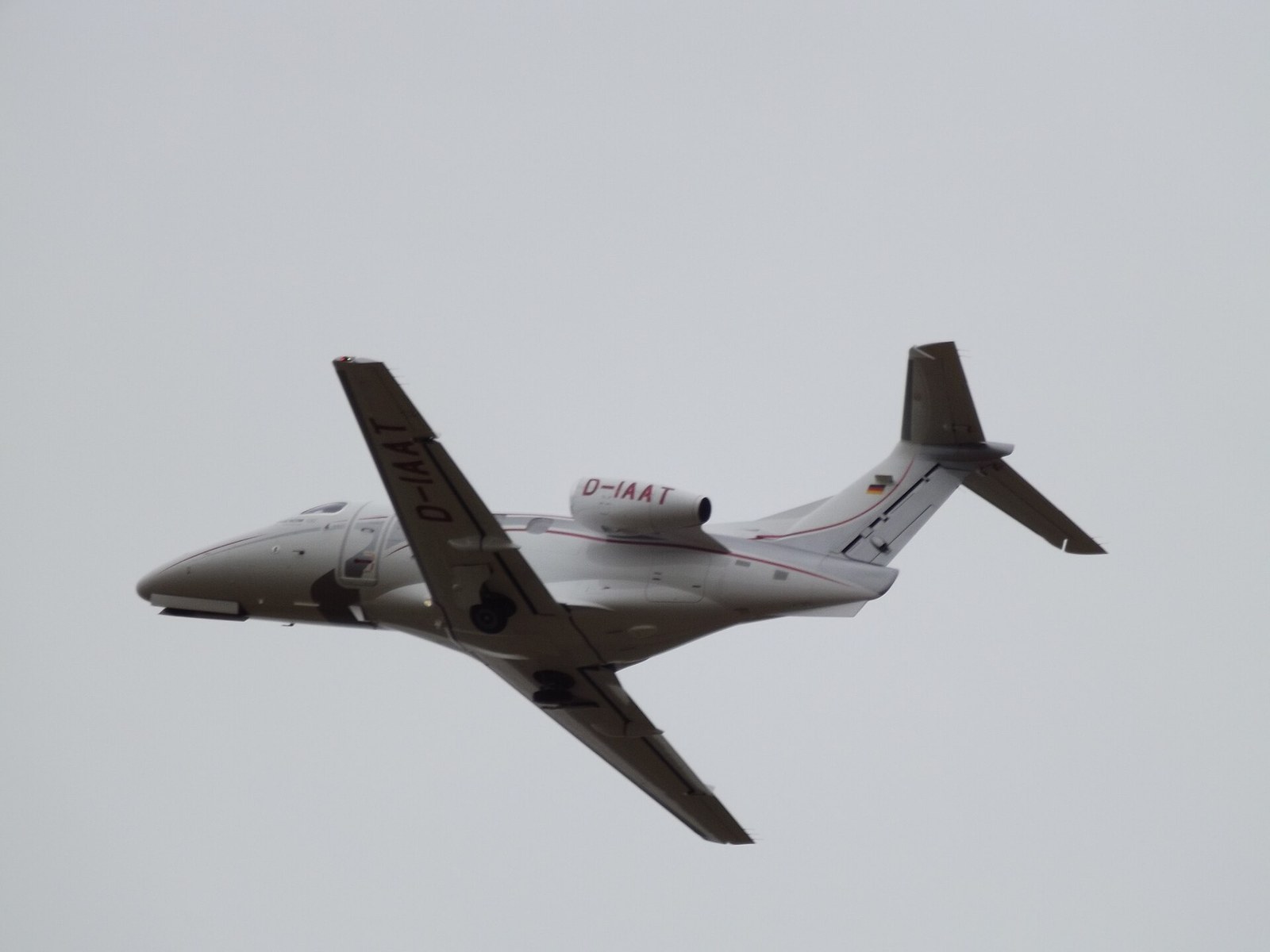
Embraer Phenom 100 D-IAAT
Embraer Phenom 100 D-IAAT · James from Cheltenham · CC BY-SA 2.0 via Wikimedia Commons
Embraer Phenom 100 N669AS
Embraer Phenom 100 N669AS · ZLEA · CC BY-SA 4.0 via Wikimedia Commons

SPECIFICATIONS

Embraer Phenom 100EV specifications

Passengers4
Range1,178 nm
SpeedMach 0.70
Cabin height4'11"
Cabin width5'1"
Baggage53 cu ft
Runway3,190 ft

CABIN EXPERIENCE

On board the Embraer Phenom 100EV

  • Four club-style seats
  • Private aft lavatory
  • BMW Designworks interior

BEST ROUTES

Where the 100EV flies best

London → Paris

from £3,100

Geneva → Milan

from €2,900

BROWSE ALL ROUTES →

CHARTER PRICING

Embraer Phenom 100EV charter pricing

ROUTEESTIMATED PRICE
London → Amsterdamfrom £3,000
Boston → New Yorkfrom $3,800

Indicative all-inclusive one-way pricing — aircraft, crew, fuel, handling, catering and taxes. Confirmed quote in 10 minutes.

WHO SHOULD CHARTER THIS

Why choose the Embraer Phenom 100EV?

The right client profile for the 100EV: 4 passengers, missions inside its 1,178 nm range, and routes where the light jet cabin size is the sweet spot between cost and comfort.

  • Largest cabin in the VLJ class
  • Single-pilot certified
  • Class-leading short-runway capability

RANGE & LIMITATIONS

What the 100EV can — and can't — do

Non-stop range

1,178 nm with typical payload. Missions beyond this figure require a technical fuel stop — expect 30–45 minutes on the ground and a modest re-quote. On strong headwinds or full-cabin days the practical range trims by 5–10%.

Runway requirement

Balanced-field length around 3,190 ft. Rules out very short-strip airfields (Courchevel, Lugano, London City steep-approach) unless the airframe is specifically certified — our ops team validates every airport pairing before we confirm the quote.

Payload & baggage

53 cu ft of hold space with 4 passengers. Ski, golf and dive equipment fit for most parties; larger groups with full luggage should size up one category to preserve the range figure above.

FAQ

Frequently asked

Is Wi-Fi available onboard?

Yes — most aircraft in this class offer high-speed Ka-band or Starlink connectivity suitable for video calls and streaming throughout cruise.

Can pets fly on board?

Many operators permit pets in the cabin, subject to aircraft-owner approval, destination rules, documentation and any operator-specific charges. Tell us the species and weight when you request a quote.

How quickly can the aircraft be ready?

Once a quote is confirmed, this aircraft can typically be positioned within 2–4 hours anywhere in its home region, and within 24 hours globally.

FURTHER READING

Planning the 100EV for business or leisure

SIMILAR AIRCRAFT

Also in Light Jet

HEAD-TO-HEAD

Compare the 100EV

ALL COMPARISONS →

EMBRAER PHENOM 100EV CLUSTER

Everything connected to the Embraer Phenom 100EV

Ready to charter the Embraer Phenom 100EV?

Quotes in 10 minutes. Aircraft positioned within hours. 24/7, worldwide.

REQUEST A QUOTE

Embraer Phenom 100EV gallery

Exterior and cabin photography of the Embraer Phenom 100EV type.

Limitless Sky ownership desk

What it costs to buy, operate and charter out a Embraer Phenom 100EV

A five-year planning model on the same assumptions as our ownership vs charter vs fractional analysis: 100 owner-occupied hours a year, 15% owner positioning, 170 third-party charter hours sold on a managed certificate at an 85% owner revenue share, and 22% market depreciation over the hold.

Acquisition

Indicative market value€2.71m – €4.03m
Model purchase price used€3,300,000
Inspection, legal and delivery (2%)€66,000
Residual value after 5 years€2,574,000

Annual cost of operation

Fixed cost (crew, hangar, insurance, management)€260,000
Direct operating cost per aircraft hour€800
Owner missions (114.99999999999999 aircraft hours)€92,000
Annual cash operating cost before charter€352,000

What renting it out brings in

Charter sold (170 occupied hours at €2,400)€408,000
Owner share at 85%€346,800
Direct cost of those flights (204 aircraft hours)(€163,200)
Net annual contribution to fixed costs€183,600
Share of fixed costs covered71%
Charter hours needed to cover all fixed costs241 hours

Five-year verdict

Net five-year cash cost, with charter income€1,711,220
Cost per owner-occupied hour€3,422
Cost per hour if never chartered out€5,258
Opportunity cost of tied-up capital (4%/yr)€660,000
Methodology and sources— how these numbers are built

Purchase price band

The €2.71m€4.03m band is an indicative pre-owned range for a well-maintained, mid-life Embraer Phenom 100EV on a current maintenance and engine programme, in a typical European charter specification. It is built from published asking prices and retail transaction ranges (Duncan Aviation market letters, AvBuyer and Controller listings, VREF and Aircraft Bluebook retail guidance), then narrowed against what our desk sees pay-and-close in Europe. The model uses a single point inside that band, €3,300,000, so the five-year output is reproducible. Serial number, total time, cycles, engine-programme enrolment, avionics mandates, interior age and import/VAT status routinely move a real transaction outside the band in either direction.

Fixed cost assumptions

€260,000 a year covers two (or, for larger cabins, three) crew with training and recurrent sim, hangarage at a European base, hull and liability insurance, the management fee on a third-party AOC, navigation and weather subscriptions, and scheduled non-flying charges. It excludes financing, tax, extraordinary maintenance events and cabin refurbishment. Sources are operator and management-company budget templates for the type, cross-checked against NBAA and Conklin & de Decker fixed-cost structures.

Direct operating cost per hour

€800 per aircraft hour is fuel at prevailing European Jet A-1 pricing, engine and airframe programme accruals, APU and landing-gear reserves, landing, handling and navigation fees, catering and crew expenses. It is applied to actual aircraft hours, not occupied hours: owner trips carry a 15% positioning uplift and third-party charter carries 20%, which is what repositioning empty legs cost in practice.

Charter revenue estimate

170 third-party occupied hours a year at a wholesale base rate of €2,400 per hour is what a managed Embraer Phenom 100EV realistically sells in Europe once owner availability, maintenance downtime and seasonality are taken out — not the retail rate a client pays. The rate is the operator-level rate band we transact at on Avinode and directly with operators; the owner keeps 85% under a standard management agreement, with the balance retained by the operator. Ferry, fuel surcharges, de-icing and overnights on charter missions are captured in the direct-cost line rather than netted off the rate.

Depreciation and the five-year frame

22% market depreciation is applied over a 5-year hold, with 2% acquisition costs (inspection, legal, delivery) at entry and 3% selling costs at exit. Owner utilisation is held at 100 occupied hours a year across every aircraft so types can be compared like for like. Capital opportunity cost is shown separately at 4% simple per year and is not added into the cash cost. The same frame drives our ownership vs charter vs fractional analysis and the most profitable jets to own ranking, so the three never disagree.

Review cadence

Values are reviewed each quarter against the same sources and re-published in one dataset, so every aircraft page moves together. Read our editorial standards for how we source and correct figures.

Indicative planning estimates prepared by the Limitless Sky desk — not an appraisal, charter quotation, offer or tax advice. Figures are pre-tax and pre-financing and exclude recoverable VAT, extraordinary maintenance and substitute lift during downtime. Actual values depend on serial number, hours, maintenance and engine-programme status, specification, base and charter demand. Ask the desk for a tail-specific forecast, or charter the Embraer Phenom 100EV instead and skip the balance sheet entirely.

Interactive · ownership desk

Run your own numbers on the Embraer Phenom 100EV

Move your annual flying, the charter hours you are willing to release, the management fee your operator charges and how long you intend to hold the aircraft. Buy versus charter-out break-even updates instantly.

Your assumptions

Buy versus charter out

Net cost of owning over 5 years€1,711,220
Cost per owner-occupied hour€3,422
Same hours bought on the charter market€1,416,000
Indicative retail charter rate per hour€2,832
Owning costs more€295,220

Break-even

Owner hours a year where owning beats chartering131 h
Charter hours a year to cover the whole fixed budget241 h
Charter income after the cost of flying it€183,600 / yr
Share of fixed costs covered71%

At 100 hours a year, chartering is cheaper than owning the Embraer Phenom 100EV by €295,220 over the hold. Owning turns cheaper from around 131 hours a year.

Pre-tax, pre-financing planning estimates on the same frame as the tables above: 15% owner positioning, 20% positioning on charter, 2% acquisition cost, 3% selling cost, and published five-year depreciation scaled linearly to your resale horizon. Retail comparison rate is the wholesale base rate plus 18%. Ask the desk for a tail-specific forecast.

KNOWLEDGE GRAPH

Where the Embraer Phenom 100EV fits in our aviation graph

Routes, destinations and airports this aircraft typically serves — plus peers in the same class and family.

Book HereDo you have a question?