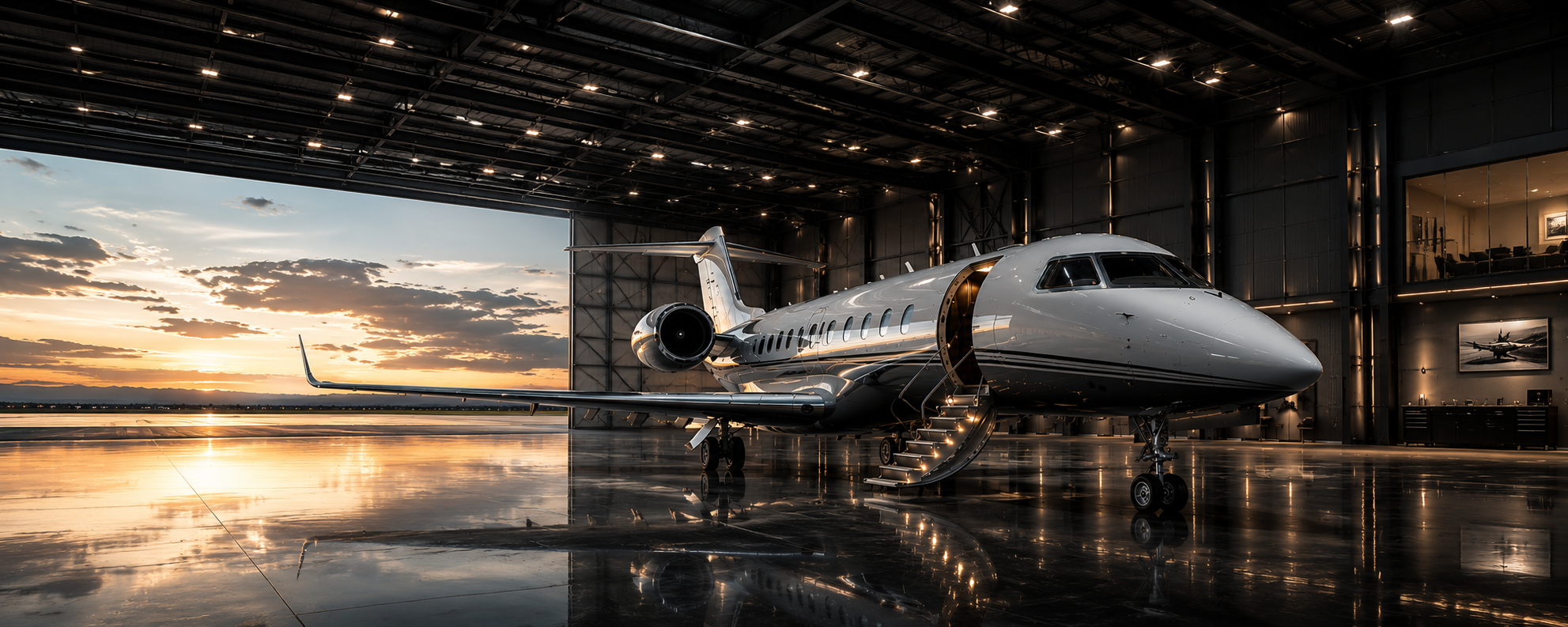
Ask a charter broker to name a "sensible" light jet and the shortlist has been the same for years: the Phenom 300, the CJ3+, a well-kept Learjet 45XR — and, quietly, the Hawker Beechcraft 400XP. The 400XP does not have the newest cabin or the lowest fuel burn in its class. It has something else: a genuinely fast cruise, an unusually square cabin for a light jet, and a US charter fleet deep enough that you can almost always find one within positioning distance.
This guide walks through what the 400XP actually is, where it came from, what it can do on a real charter mission, and when it is (and isn't) the right aircraft. For the specification sheet and live pricing, see the Hawker 400XP charter page.
A short history — from Mitsubishi Diamond to Hawker 400XP
The 400XP's story begins in Japan. Mitsubishi Heavy Industries designed the aircraft as the MU-300 Diamond in the 1970s — a clean-sheet business jet with an unusually square cabin cross-section. Beech Aircraft acquired the programme in the mid-1980s, re-certified it under FAA rules and marketed it as the Beechjet 400, then the improved Beechjet 400A. After Raytheon's business-jet unit merged into Hawker Beechcraft, the airframe was refreshed again in the early 2000s with updated avionics and interior and rebadged as the Hawker 400XP.
That heritage matters when you search for one. The same aircraft appears in registrations and fleet databases under half a dozen names — Mitsubishi MU-300 Diamond, Beechjet 400, Beechjet 400A, Raytheon Beechjet 400A, Hawker 400, Hawker 400XP, Hawker Beechcraft 400XP — and the practical differences between a late-life 400A and an early 400XP are surprisingly small. The military version, the USAF's T-1A Jayhawk, is the same underlying airframe again, adapted for advanced pilot training.
The 400XP by the numbers
- Class: Light business jet, twin-engine (Pratt & Whitney Canada JT15D).
- Passengers: Seven in the standard double-club charter layout.
- Range: Practical 1,300–1,500 nautical miles with reserves — plan a fuel stop for anything materially beyond that.
- High-speed cruise: Approximately Mach 0.78, or 430–450 knots (~830 km/h) — competitive with much newer light jets.
- Cabin: Squared-oval flat-floor cross-section, 4'9" tall, 4'11" wide, 53 cu ft external baggage.
- Runway: Around 3,950 ft balanced field at MTOW at sea level; more required at hot/high airports.
Brochure ranges are typically higher, but they assume favourable winds, reduced payload and long-range cruise. On a real seven-seat charter mission with IFR reserves and an alternate, the honest planning number is 1,300–1,500 nm.
What the 400XP can actually fly, non-stop
The 400XP is a regional aircraft, not a transcontinental one. Sample non-stop pairs at typical payload:
- New York (Teterboro) → Miami — route brief
- Los Angeles → Denver — high-altitude approach; check payload/temperature
- Dallas → Chicago
- London → Nice — comfortable non-stop; see the London–Nice route page
- Paris → Rome
- Singapore → Bangkok
Same-day US transcon (New York → Los Angeles, for instance) is not a 400XP mission — that's Challenger 350 / Citation Longitude territory, covered in our choosing the right private jet guide.
Inside the cabin
The 400XP's most distinctive feature is the shape of its cabin. Where most light jets narrow toward the floor, the Beechjet airframe uses a squared-oval cross-section — the practical effect is more shoulder room, straighter walls and a flat floor. Seven passengers sit in a true double-club layout with individual worktables, an aft enclosed lavatory and a modest refreshment centre. Baggage lives in an external tail-cone compartment: 53 cubic feet, best suited to soft-sided luggage, moderate golf and reasonable ski loads (subject to payload).
Cabin condition varies more than on newer types — the airframe has been in production or service for four decades, and refurbishment history is now the single biggest driver of the passenger experience. A refreshed 400XP will offer updated seating, cabin lighting, power outlets and Wi-Fi; an unrefurbished one will feel its age. Always ask the broker for interior photos of the exact tail before confirming.
Where the 400XP wins — and where it doesn't
It wins on: hourly rate, availability across the US Part 135 fleet, cruise speed for a light jet, and cabin width for seven-passenger business trips. On a Miami to Nassau, London to Nice, or Teterboro to Boston hop, the 400XP is often the sharpest quote on the desk.
It doesn't win on: fuel burn per hour (the JT15D generation is thirstier than modern turbofans on the Phenom 300 or CJ3+), stand-up cabin height, or long-leg range. Hot-and-high airports also demand more runway than newer light jets, and payload/fuel trade-offs matter more than on a comparable Embraer.
If cost per hour and cabin comfort matter more than absolute range, the 400XP is a strong pick. If range and modern efficiency are the driver, look at the Embraer Phenom 300 or Cessna Citation CJ3+. For a stand-up cabin in the Hawker family, step up to the midsize Hawker 850XP or Hawker 900XP.
Nextant 400XT and 400XTi — the second life of the airframe
The Beechjet / 400XP became one of business aviation's best-known remanufacturing candidates. Nextant Aerospace developed the Nextant 400XT, and later the 400XTi, by extensively upgrading existing 400-series aircraft: the original Pratt & Whitney Canada JT15D engines were replaced with Williams FJ44 turbofans, and the aircraft received modern Rockwell Collins Pro Line 21 avionics, aerodynamic refinements and refurbished cabin interiors.
The result is materially different economics — meaningfully lower fuel burn, extended range in the 2,000 nm class, and a cabin experience closer to a new-build light jet — on the same square-cabin airframe. If you find a Nextant 400XT / XTi on quote, treat it as a separate aircraft: better range and efficiency, higher hourly rate, tighter availability.
A quick note on "Hawker 400XP" vs "Hawker 4000"
They share a "400" designation and nothing else. The Hawker 4000 is a much larger composite super-midsize jet with a stand-up flat-floor cabin and 3,000+ nm range — a different aircraft, in a different class, for different missions. The Hawker 4000 page covers that airframe in detail.
What a real 400XP quote costs
Charter pricing on any light jet is trip-based, not tail-based — flight time, positioning, landing and handling fees, crew, taxes, overnight rules, de-icing and one-way scheduling all move the number. Indicative one-way quotes on common 400XP pairs currently sit at:
- Los Angeles → Las Vegas — from $7,400
- Teterboro → Boston — from $9,800
- London → Geneva — from £9,400
- Paris → Nice — from €8,900
- Dallas → Chicago — from $12,900
On short repositioning legs it is also one of the aircraft types most likely to show up on our live empty-leg feed at 40–70% off retail — worth checking before committing to a scheduled charter on a compatible route.
The verdict
The Hawker Beechcraft 400XP is not the newest, quietest or most efficient light jet in the sky — and it never claimed to be. What it is, is a proven, fast, seven-seat airframe with unusual cabin geometry, deep US availability and one of the most attractive light-jet quotes on any given day. For regional business trips, family hops and time-sensitive missions inside a 1,300–1,500 nm radius, it earns its place on the shortlist. For longer legs or a more modern cabin, step up — or take a look at the Nextant remanufacture of the same airframe.